الثلاثاء، 1 نوفمبر 2005

Thoughts on Housing Construction

Housing construction increased in September to the highest level in seven months according to the Commerce Department's most recent data. Construction of new homes and apartments rose by 3.4 percent last month to a seasonally adjusted annual rate of 2.11 million units, the fastest pace since last February. Analysts had been forecasting that housing construction would decline by 1.7 percent in September, believing that increases in mortgage rates would finally start to cool the red-hot housing market.

We will soon find out if September was one last hurrah or if the party continues. New Residential Construction data for October 2005 will be released on Thursday, November 17, 2005, at 8:30 A.M. EST.

Previously we reported The party is over in Boston but optimism still abounds in many market. City by city the party light will go out but the name of the game right now seems to be "Build or Die".

Following is the Weekly Mortgage Applications Survey for the week ending October 21.
WASHINGTON, D.C. (October 26, 2005) - The Mortgage Bankers Association (MBA) today released its Weekly Mortgage Applications Survey for the week ending October 21. The Market Composite Index, a measure of mortgage loan application volume, was 679.1, a decrease of 7.9 percent on a seasonally adjusted basis from 737.5, one week earlier. On an unadjusted basis, the Index increased 2.2 percent compared with the previous week but was down 3.7 percent compared with the same week one year earlier.

The seasonally-adjusted Purchase Index decreased by 7.4 percent to 466.4 from 503.9 the previous week whereas the Refinance Index decreased by 8.5 percent to 1916.8 from 2095.7 one week earlier. Other seasonally adjusted index activity includes the Conventional Index, which decreased 8.1 percent to 1014.3 from 1103.8 the previous week, and the Government Index, which decreased 4.9 percent to 120.1 from 126.3 the previous week.

The four week moving average for the seasonally-adjusted Market Index is down 1.5 percent to 706.2 from 716.8. The four week moving average is down 0.9 percent to 478.4 from 482.6 for the Purchase Index while this average is down 2.3 percent to 2031.2 from 2078.7 for the Refinance Index.

The refinance share of mortgage activity decreased to 42.5 percent of total applications from 42.8 percent the previous week. The adjustable-rate mortgage (ARM) share of activity increased to 29.5 percent of total applications from 29.3 percent the previous week.

The average contract interest rate for 30-year fixed-rate mortgages decreased to 6.06 percent from 6.09 percent on week earlier, with points decreasing to 1.21 from 1.29 (including the origination fee) for 80 percent loan-to-value (LTV) ratio loans.

The average contract interest rate for 15-year fixed-rate mortgages decreased to 5.57 percent from 5.62 percent, with points increasing to 1.30 from 1.29 (including the origination fee) for 80 percent LTV loans.

The average contract interest rate for one-year ARMs increased to 5.37 percent from 5.34 percent one week earlier, with points remaining at 1.00 (including the origination fee) for 80 percent LTV loans.
Even though Long term interest rates have pretty much been rising for several months and rates are at the very upper end of their ranges, overall refinancing avtivity is still reasonably strong 42% of the total volume of mortgage applications. There are several possible explanations that I can think of.
  1. People are so desperate for cash to support ongoing consumption that they are simply forced to pay higher rates to get it
  2. People have once again racked up huge credit card purchases and are going thru yet another round of paying off high interest debt for lower interest debt
  3. People are scared to death of all these rate hikes and are rushing to lock in fixed rates and get out of their ARMs
It is probably some combination of those factors but the rate of new ARMs is still holding at 30% or so, higher in bubble areas from numbers that I have seen.

Many seem to thing that housing will plateau and there is no fear of a real slump. At the top of the list in believing the "permanently high plateau" theory is David Seiders, the chief economist for the National Association of Home Builders. According to Seiders, single-family starts numbered about 1.6 million, in 2004. He expects another record this year, even as the industry begins to hit "the plateau we've been watching and waiting for." Next year, Seiders said, he projects 1.58 million single-family-home starts.

Also chiming in on the permanently high plateau theory is Erik Bruvold of the San Diego Regional Economic Development Corp. in the San Diego News article Housing economists raise yellow flag over San Diego.
Mr. Bruvold predicted a flattening in prices rather than a dramatic falloff. Already, the inventory of homes on the market is growing and sales prices are lower than asking prices. "I think we've hit a plateau," Bruvold said. "I would not refer to it as a turning point."

David Berson chief economist of Fannie Mae and David Seiders, chief economist for the National Association of Home Builders also seem to be giving some credence to the "plateau theory". "Prices are so high that at some point there is the possibility people may simply decide it's too expensive to move there," Berson said. "Alternatively, prices may simply slow for a period of slow or no price gains."
David Seiders said constraints on supply will tend to keep prices from falling. "That makes me think prices are going to stick," he said.
No one seems to be as optimistic as the Toll Brothers according to the New York Times article Closing Ground.
At the moment, Toll controls enough land for nearly 80,000 houses. Its competitors, which tend to build lower-priced houses on smaller lots, have even larger accumulations. K. Hovnanian has land for more than 100,000 houses. Pulte Homes holds 350,000 sites. Still others - Lennar, Centex Homes, D. R. Horton, KB Home - control hundreds of thousands as well. And all of them are in ferocious pursuit of more.

The company expects to grow by 20 percent for the next two years and then will strive for 15 percent annually after that. Those estimates suggest that the company's expected production of around 8,600 houses this year will expand to at least 15,000 houses by 2010. Individual Toll developments now range in size from a few dozen to 3,000 houses.
"Why can't real estate just have a boom like every other industry? Why do we have to have a bubble and then a pop?" asked Toll.

I wonder: Does Toll have any idea of what housing prices would look like if prices grow at 15-20% rate annually? Clearly it is silly at best and dishonest at worst to suggest such a thing. Does he really believe this or is this just yapping for shareholders? From where I sit, it's a pipe dream to think that this expansion can continue with housing affordability at all time lows, and real wages falling. What Toll is suggesting is financially impossible.

All of these housing cheerleaders sound just like Yale professor Irving Fisher, who just before the stock market crash in 1929, declared that stocks had reached "a permanently high plateau."

Mish's view of the "Permanently High Plateau" theory is right here:
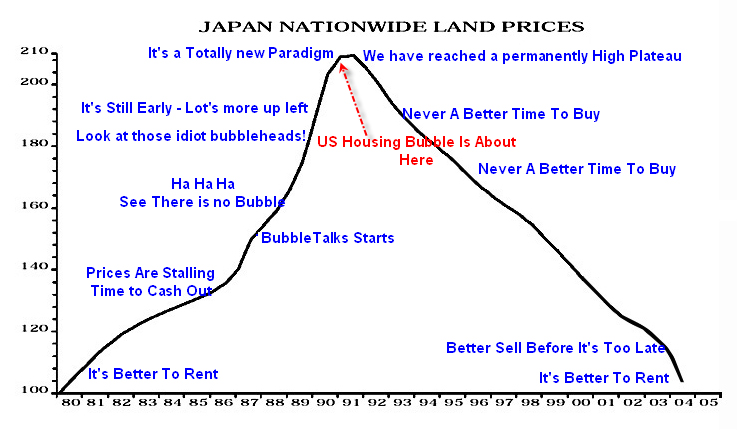

Note: I made that chart in spring of 2005. Please mentally shift the arrow one notch to the right. Perhaps we stay up here a bit longer forming a broader top, perhaps not, but there sure will not be anything remotely permanent about this plateau.

When Toll asks: "Why can't real estate just have a boom like every other industry? Why do we have to have a bubble and then a pop?" I wonder: Has Toll ever studied economic cycles? Is his memory so poor that he has already forgotten what happened 4 years ago in a stock market bust led by telecom and dot coms? Exactly what boom is he referring to that "like every other industry" can go on forever?

Susan Wachter, a housing economist at the Wharton School at the University of Pennsylvania, remarks: "The fact of the matter is that housing prices are increasing in the U.S., faster than inflation, in ways we haven't seen before. Ten years running. It's the first time in keeping these numbers that we've ever had a run like that." Mish asks: Does that sound remotely sustainable?

Noland sure nailed it in a recent Credit Bubble Bulletin
Analyzing today’s Mortgage Finance Bubble does bring to mind speculative dynamics at play during the late-eighties commercial real estate Bubble. Despite increasing signs of late-cycle stress and fundamental deterioration (rising vacancy rates, over-supply, and sagging rents), it took quite some time to pacify (and then quickly crush) the speculative spirits that had blossomed during the boom. The boom-time financial infrastructure and the resulting Wall of Liquidity continued to finance additional building, with both the quantity and quality of the projects guaranteeing a devastating down-side of the Credit cycle. We saw similar dynamics at work throughout the tech and telecom industry during that fateful period 1999/2000.

Today, the system is basically preordained to finance and construct at least two million new residences a year, notwithstanding fundamental developments (rising inventory of unsold units!). Too many of these homes will be oversized, upscale, and constructed in the hot/susceptible markets (California, greater Washington D.C., Miami, Las Vegas, etc.). The vulnerable condo, investment property and vacation home sectors will see more than their share of construction activity. And the reality of the situation is that this housing juggernaut is destined to pressure exiting home prices and exacerbate post-Bubble system impairment. You can throw any notion of a self-adjusting and correcting system out the window.
It is actually "build or die" for all of the home builders. Private companies could simply pull their chips off the table, finish selling what inventory they have, scale down and slowly go towards extremely high cash ratios. If Toll Brothers did that, their stock would crash. Thus, Toll Brothers and all of the other public home builders will buy land and build and attempt to expand no matter what the market climate is, no matter what the cost of materials is, and no matter what national housing inventories levels are. As public companies, being bearish is simply not an option no matter how bleak things might look. This is exactly why home builders go bankrupt at the bottom of every cycle. It happens every time. Builders will keep building as long as banks will lend them money. They will not stop because they fear they will lose their crews, their market share, or their stock options. Home builders will run under the model of "build or die" until margins are squeezed so hard they sustain heavy losses. At some point "build or die" will morph into "stop building or die". At that point concerns about market share and promises of 20% growth will both go out the window. By then it will be too late.

This cycle will not be any different. I do expect some home builder bankruptcies out of this mess but it is not easy to predict which ones.

Here is what the housing evidence suggests:
  1. Homebuilders are clearly ignoring business cycles, affordability issues, tightening credit, and liquidity concerns. Money has been too easy for too long for anyone to understand what might happen in a liquidity crunch.
  2. Homebuilders will keep buying more and more land and adding more and more to housing inventory in a foolish attempt to grow 20% every year fighting for "market share" right at the peak of the boom.
  3. No one seems to see or believe the devastating consumer led recession that is staring them in the face. It's simply "build or die".
  4. People will likely borrow to buy this housing bubble until lending literally seizes up.
I believe we can now answer Toll's question: "Why can't real estate just have a boom like every other industry?" My answer is "Patience Mr. Toll, you will, and it will end up looking a lot like the telecom bust of 2000 as well."

Mike Shedlock / Mish
http://globaleconomicanalysis.blogspot.com/

الاثنين، 31 أكتوبر 2005

The Kids Have Spoken

The voting is finished, the ballots have been cast, and the kids have spoken.
Mish is pleased to announce the winner of this year's Halloween favorites.
Without further ado, the overwhelming favorite for the second year in a row is (drum roll please)......Tootsie Roll Pops.

No, for the record I do not get anything out of this endorsement (other than I have been eating them all day myself too).

This Halloween we offered a basket of candy including, Snickers, M&Ms, Butterfingers, Milky Ways, and Tootsie Roll Pops. When holding out the basket the first choice was (by guesstimate) Tootsie Roll Pops more than 65% of the time.

One "Little Princess" selected a red Tootsie Roll Pop put it down, picked it up and put it down again. Wondering what was on her mind, I offered "It's OK you can take two". She promptly picked up the Cherry Tootsie Roll Pop and then without hesitation selected a Grape Tootsie Roll Pop as her second choice. The original dilemma was not what candy to choose but what flavor to choose.

Boys on the other hand reacted differently. Originally taking one, when told they could have two, just grabbed a handful of everything. Perhaps this means girls are really better at math or perhaps this means boys are better at seizing opportunity when presented. I will leave this debate to Mish readers.

Then again, the latter was not uniform. One "Little Devil" selected a Chocolate Tootsie Roll Pop and that was all he wanted it seems. I had to ask "Are you sure you don't want another one?" He just stood there so I handed him another selection for his bag.

There you have it folks.
By popular demand "The Kids Have Spoken".
Mish is pleased to recommend that next Halloween parents everywhere stock up on Tootsie Roll Pops.

PS. Please buy an extra bag for yourself. Save some for the kids and if there are still some leftover please send them to me.

Mike Shedlock / Mish
http://globaleconomicanalysis.blogspot.com/

الأحد، 30 أكتوبر 2005

3rd Quarter GDP

Here is how the 3rd quarter GDP was actually reported:
Economy Grows at an Energetic Rate in 3Q - Despite Hurricanes

WASHINGTON (AP) -- Economic activity expanded at an energetic 3.8 percent annual rate in the third quarter, providing vivid evidence of the economy's stamina even as it coped with the destructive forces of hurricanes Katrina and Rita. The latest snapshot of the country's economic performance, released by the Commerce Department on Friday, even marked an improvement from the solid 3.3 percent pace of growth registered in the second quarter. Growth in the third quarter was broad-based, reflecting brisk spending by consumers, businesses and government.

The expansion in gross domestic product in the July-to-September quarter, the strongest since the beginning of the year, also exceeded many analysts' expectations. Before the report was released, they were forecasting the economy to clock in at a 3.6 percent annual rate.

Despite the sting of high energy bills, consumers continued to spend, doing their part to keep the economy rolling in the third quarter. Consumers' boosted spending at a brisk 3.9 percent rate, the strongest pace since the end of last year.
Here is one possible alternative:
Economy Grows at an Energetic Rate in 3Q - Because of the Hurricanes

WASHINGTON (AP) -- Economic activity expanded at an energetic 3.8 percent annual rate in the third quarter, providing vivid evidence of dollars flooding the economy in the wake of the hurricanes. Washington flooded the economy with close to $100 billion in relief efforts. The boost is expected to be temporary as is widely known by economists as "The broken window fallacy".

Benefiting most from these relief efforts were roofers charging the US government as much to temporarily patch roofs with plastic as an entire new roof should cost. Also benefiting from this disaster were truckers hauling ice to nowhere. That ice was never used and either melted or returned to the place of origin. Insurance companies paid out billions of dollars worth of claims and that money was spent as well. Food vendors in Houston benefited by charging extravagant prices to supply food to the refugees.

Gasoline prices skyrocketed, accounting for much of the increase in consumer sales. Despite the string of high energy bills, consumers continued to spend simply because that had to if they wanted to heat or air condition their homes or drive anywhere.

Add it all up and the rise in 3rd quarter GDP was a mirage.
Let's consider all of the likely alternatives and see how they stack up:
  1. GDP really did rise. It's a good thing. God bless consumers.
  2. No one really knows what the GDP did as it is so grossly distorted already and hurricane relief made it even more so. For a look at some of those distortions please consider Grossly Distorted Procedures. Besides, GDP is backward looking and the housing slump to which we can look forward to is just starting. The fallout will be immense.
  3. GDP rose because consumers foolishly went deeper debt spending driving savings rates further into negative territory. This can hardly be a good thing.
  4. GDP rose because of a rapid rise of government spending in the wake of the hurricanes. This is not a good thing and is part of the reason for recently rising interest rates.
Which of those are likely?
For anyone that wants to party now and is not concerned about the hangover later, (which is almost everyone, especially the economic cheerleeders on CNBC), the answer is number 1. To those folks, the answer is always "rah rah siscooom bah, gooooooo consumer" and no possible chance to portray things as being better than they really are is ever passed up. If the GDP was down they would be looking ahead to the "recovery" after blaming the weather. The thinking person on the other hand knows full well the answer is a combination of 2, 3, and 4.

Charles Mackay, writing for the WallStreetExaminer touched upon this line of thinking in The Secret Recession. Let's have a look.
Hidden behind the "strong" GDP figures is an ongoing consumer recession. Buried beneath the mass of heavily manipulated economic statistics, the Bureau of Economic Analysis notes that real* disposable income fell at an annual rate 0.9% in the third quarter. It went from a $8,128.7 billion annual rate in the second quarter to $8,110.5 billion in the third quarter. Already heavily indebted, consumers resorted to draining cash from their bank accounts to maintain prior spending levels. The BEA says the amount of negative savings reached an annual rate of $100 billion in the quarter – or put another way, -1.1% of income. This is duly confirmed by the continuing drawdown in the M1 money supply we have seen for a number of weeks now.

The BEA also issued a stern note of caution about reliability of their GDP figures:

The Bureau emphasized that the third-quarter "advance" estimates are based on source data that are incomplete or subject to further revision by the source agency. The third-quarter "preliminary" estimates, based on more comprehensive data, will be released on November 30, 2005.

Government spending rapidly accelerated to a 7.7% rate in the third quarter. This spending may further add to the misconceptions about just how strong the economy really is.
"May add to the misconceptions" or "Did add to the misconceptions"?
I think the latter. At any rate, thanks for the numbers Mr. Mackay, it helped me put the finishing touches this weekend on a piece I started soon after I heard the noise and saw all the pom-poms waving. As always, it was a sight to behold.

Mike Shedlock / Mish
http://globaleconomicanalysis.blogspot.com/

US. misses softwood deadline

The U.S. missed a deadline to resolve its softwood lumber dispute with Canada.
Is anyone surprised?

US. misses softwood deadline
Foot-dragging comes days after PM called for proof Washington respects NAFTA

The United States missed a key deadline yesterday for complying with a NAFTA ruling that should have dramatically cut duties in the bitter softwood dispute, denying Canada the gesture of good faith it's been requesting before it would resume talks to settle the conflict.

Yesterday's foot-dragging especially angered Ottawa because it was only on Monday that Prime Minister Paul Martin called on U.S. Secretary of State Condoleezza Rice to provide proof that Washington still respects the North American free-trade agreement.

Canadian-U.S. relations concerning the $8-billion softwood dispute have been in a downward spiral since August, when Washington spurned a different NAFTA ruling that should have ended the conflict.

In this separate case, a NAFTA panel of trade adjudicators has ruled five times -- most recently Oct. 5 -- that the United States's calculation of part of its softwood duties was illegal under U.S. law and it has five times urged Washington to bring its results into line.
NAFTA ruled five times that the US is wrong?
Does the US care?
If so how?
At 5 p.m. Eastern time, the U.S. government announced it had some questions about the panel's ruling and that softwood duties would stay in place. It requested "clarification" of the NAFTA decision and asked for more time to comply. Yesterday was the last possible day for Washington to respond to the NAFTA ruling.
After 5 rulings that the US is in violation of NAFTA, the US wants "clarification" at the 11th hour. What can possibly need to be clarified at this point?
"This seems to be another example of the lengths they will go to avoid offending, at least in the short term, special interest groups like the [U.S. Coalition for Fair Lumber Imports]," an official said.

"I hardly think this can be construed as the signal of good faith that the Canadian government was looking for," said Carl Grenier, executive vice-president of the Free Trade Lumber Council, which represents about 40 per cent of lumber exports to the U.S. market.

The B.C. Lumber Trade Council, representing half of U.S.-bound lumber exports, accused Washington of employing "delay tactics."

The U.S. government, which this week asked Canada to tone down its "apocalyptic language" on softwood, insisted it's playing fair.

"This administration is fully committed to NAFTA and to coming to a lasting agreement with Canada to resolve this dispute," Commerce Secretary Carlos Gutierrez said.

International Trade Minister Jim Peterson called on Washington to respond promptly. "It is up to the United States to show that the institution of the NAFTA means something," he said. "Rules are rules, you can't just pick and choose."
In a nutshell, that is the mistake that Canada and other keep making: The US has proven, time and time again that it can and will pick and choose the rules it will abide by. Waiting for Washington to respond promptly to trade disputes when the US is at fault has proven to be futile.

By now it should be point blank obvious that the word of the US (at least the word of this administration) is totally worthless. Therefore, it most assuredly is not up to the US "to show that the institution of the NAFTA means something". Rather it is up to everyone else to make it extremely painful for the US to not honor its trade agreements.

Hardball is the only thing this administration understands.
It is up to Canada to prove it is willing to play hardball.
That is the bottom line. No more, no less.

Mike Shedlock / Mish
http://globaleconomicanalysis.blogspot.com/

الجمعة، 28 أكتوبر 2005

A National Mortgage Broker Chimes in on Boston

The following is from Dave Donhoff, a national mortgage banker/broker:

Hi Mish,
Regarding: The The party is over in Boston
Snip...
No buyers? Fancy that. On a $70,000 price cut no less. Let's see, is that a 15% price reduction? Yep. Does that include a 6% fee to the real estate agent/broker? Nope.
EndSnip...

Anecdotally I'm seeing increased inquiries in foreclosure bailouts and distressed requests for cashout refis (to fund reserves because payments can't be met... which, of course, we do not do) from Greater Boston, and the California Bay Area.

FURTHER, nationwide the rental levels are breaking from stagnant to a creep to a LEAP in some markets...

If there was EVER a time to get buttoned up as a real estate investor... the markets' about go go on deep-discount sale. Probably "once in a lifetime" buying opportunities will begin opening up to the diligent who are cash & credit strong.

Cheers,
Dave Donhoff
National Mortgage Banker/Broker

Instride on the Motley FOOL replied with:

I am not a realtor and do not play one on the internet. I am a podiatrist who happens to treat a realtor every now and then in my office. The following is scuttlebutt and fungusamentals obtained while extracting fungus while trying not to go mental.

In Weymouth, MA a second generation local family run realtor says that commissions dried up by the end of last year. There were 81 houses listed for sale in town, last year. Sales were very very good. This year, there are 244 listings but sales are dead. Nothing is moving. Three other realtors covering areas Boston south to the Cape and Islands confirm that sales have "dropped off the table this years." To quote one of them, "the glory days of 6 figure salaries are gone." Another said, "Condos are what is moving best right now, but it does not even come close to making up for the lost home sales."

I am also starting to see a phenomenon I have not seen before: for rent signs out in front of homes with for sale signs.

I also saw on the ABC News that a contractor is resorting to E-bay to sell a house he built in Ashland, MA after it did not sell for 3.3 million. He is reducing the 5 bedroom house on 2.6 acres to a "bargain" 2.8 million. I bought a 4 bedroom house on 10.2 acres ubutting a national park in Nova Scotia for 27,000 US dollars just 3 years ago. Now there is value for you.

It seems as if we have similar observations as to the Boston area market that have been arrived at in an independent fashion.

Instride
A proud member of the Boston real-Tea party

Mish reply:

Thanks Dave and Instride.
We need to stress patience on that buy side, and that can vary widely market to market. This housing bubble (and yes it is a national bubble) can crash now or it can take years to play out. I suspect local conditions will vary widely. But I sure agree with you that the best opportunities will be for "the diligent who are cash and credit strong". I would also add opportunities will be for those that understand value and local conditions and how fast they can can turn, as well as how extreme both of them can get. We have seen the extremes on the high side. It sure remains to be seen what extremes on the low side will look like. Condos in bubble areas are particularly likely to be smashed.

Mike Shedlock / Mish
http://globaleconomicanalysis.blogspot.com/

The party is over in Boston

Turn out the lights. The party is over in Boston.
Greater Boston's once-sizzling home sales have cooled so much this fall that realtors are reverting to a description not heard in a decade: "Buyer's market." From the South End to the South Shore to Cape Ann, the list of unsold properties is growing, and so are reductions in asking prices. Attractive houses in good locations with seemingly appropriate pricetags are getting scant interest. Real estate agents, who six months ago played host to streams of buyers, are now presiding over open houses that draw few if any lookers.

In Jamaica Plain, even a $70,000 price cut -- to $399,000 -- hasn't generated much interest in a two-bedroom, bi-level condo in a 19th century mansion that has been on the market for about a month. Sunday, only four people, including two curious neighbors, came to an open house.

"My seller is willing" to consider a lower price, said the broker, Anne Connolly, "but there's no buyers to deal with." The fall slowdown not only represents a sea change for sellers, who for years have enjoyed multiple offers and higher prices, but also indicates the region's bull housing market is at an end. Real estate agents say a long-predicted market correction appears underway as the gap between the price of housing and peoples' incomes -- now even wider than at peak of the 1980s housing boom -- has become too great to sustain the recent pace of sales and appreciation.
No buyers? Fancy that. On a $70,000 price cut no less. Let's see, is that a 15% price reduction? Yep. Does that include a 6% fee to the real estate agent/broker? Nope. Now bear in mind we do not know how much that house was purchased for or how much the price was jacked up to being listed originally at $469,000 but we do know that a year ago or so there was panic buying of such properties. No buyers left? All tapped out? Perhaps $399,000 is more than a tad expensive for a two bedroom condo.
Certainly, few expect an "80s-style collapse, when home values plunged 25 percent or more". Today, the economy and lenders are far stronger, and mortgage rates, which topped 10 percent when the last boom went bust, are far lower -- currently about 6 percent. In the 1980s, overbuilding, unsound lending practices, and intense speculation by investors, along with higher interest rates, sparked a real-estate crash.
Perhaps more people should expect an "80s-style collapse". Why shouldn't there be one. Today's economy is "far stonger" only because of spiraling home prices supporting consumption. Take away real estate and what have you got? Nothing, that’s what, other than boated home prices to show for Greenspan’s folly at trying to prevent deflation. "In the 1980s, overbuilding, unsound lending practices, and intense speculation by investors, along with higher interest rates, sparked a real-estate crash." Exactly what is different now, other than rampant speculation by the masses orders of magnitude higher. In fact unsound lending practices have probably never been more unsound.
While this may be good news for buyers, a slowing housing market will add a drag to Massachusetts' already sluggish economy. Real estate has been one of the state's few bright spots, generating not only jobs when most other sectors declined, but also wealth, in the form of rapidly appreciating home equity.
Actually it's not good news for anyone, at least anyone leveraged in debt. By itself it will slow the economy far more than any of the talking head economists seem to think.
Last Sunday, Globe reporters visited about a dozen open houses in different Boston neighborhoods and suburban communities. In Rockport, only four potential buyers visited a three-bedroom Cape, on the market since July despite three price reductions to $369,000 from $384,000.

At an open house in Braintree last Sunday, Jeff Brown, a 30-year-old health care professional, said he and his wife, Julie, have a price in their head, and they plan to stick to it as they shop. Last spring, Brown added, they were outbid on five homes, all sold above asking price.

Recently, after viewing a home in Norwell, listed at $645,000, Brown was told as he walked out, "We'll take $535,000."
"We'll take $535,000" huh? Why is it listed at $645,000 then? $645,000 seems a bit unreasonable to me if $535,000 is the proper value. Will anyone even offer $535,000? If so, $535,000 is a whopping 17% reduction right off the bat. Once again, that does not count agent fees. And once again we do not know what this seller paid or how high the ask price was initially jacked up. What we do see however, are signs of a few possibly panicked sellers. There will be more of them as this bubble popping progresses from locale to locale.

I want to add one other comment here. If agents are listing houses 17% too high, how quickly might a general distrust or suspicion of listing prices set in? One or two cases in Boston does not make a national reality, but one has to wonder about what might happen if "buyer suspicion" does set in. I hazard a guess those listing agents did the sellers no good at all if the real value of that house is closer to $535,000 than $645,000.

The party is clearly over in Boston. Those party lights seem to be flickering in other areas as well. I suggest that based on skyrocketing inventories everywhere I look. It is likely those flickering lights will soon be going out all over the place with a FED hell bent on containing inflation, inflation they created with reckless monetary policy. That is the sad bottom line of this mess, and there is going to be hell to pay for it too. At this point I think there are two possibilities as to how this housing bubble plays out: a complete sudden collapse in the bubble areas, or a slow prolonged torture like Japan went through. As I see it, those are the only options and neither is pretty.

Mike Shedlock / Mish
http://globaleconomicanalysis.blogspot.com/

الأربعاء، 26 أكتوبر 2005

Playing Hardball With Softwood (Part II)

I did not envision part II coming so quickly. In fact I did not plan one at all. Yet, here it is. Perhaps I had a hunch went I went back and added this finish to my previous post: "Just to make sure people do not mistake this for USA bashing, the EU is equally guilty with their protectionist farm subsidies. The difference being (for now), no one has either the political will or a bat big enough to force changes in the EU. Canada does, and they should use it."

Mish is now wondering: Is it possible to play hardball with mushheads?

Chirac says EU must never become 'mere free-trade area'.
French president Jacques Chirac said ahead of a summit on the future of Europe that the EU must never become "a mere free-trade area" In a piece in the Financial Times, Chirac also refloated his idea of "pioneering groups" to forge ahead with various EU initiatives following the rejection by French and Dutch voters of Europe's constitution.

But the French president made no mention of the contentious issue of the British rebate, which UK prime minister Tony Blair wants to avoid during tomorrow's summit at Hampton Court, outside London. The EU would be betraying its heritage if it gave up its model of the social market economy "France will therefore never let Europe become a mere free-trade area," he said. "We want a political and social Europe rooted in solidarity," he said. Chirac also said that while the EU should respect each of its members, "states wishing to act together in addition to the common policies should be allowed to form pioneering groups." He added: "Such groups must remain open to those wanting to join them. We did so with the euro."
Following is a simple translation of what Chirac is saying:
France must never give up farm subsidies no matter what the UK or anyone else thinks.

On that note, here are a few select comments that were publicly posted in response to Part I .

"The US govt doesn't run the country anymore. It is run by lobbyists. Lobbyists for big business, special interest groups and a certain middle eastern country. It must be terribly frustrating for the millions of intelligent, fair and balanced Americans."

"If the USA can bully Canada in such a manner, just imagine how the USA is bullying other countries. Now it's easy to understand why so many people around the world dislike Americans (but are afraid to say so openly fearing even more bullying)."

"The Bush administration is not in favor of Free Trade. Nor are they against Free Trade. They could care less about Free Trade. Nor do they care about being consistent on any issue or point of view. Instead they care only about rewarding friends and cronies. They are in favor of that which most benefits their corporate backers at any given moment. If 'Free Trade' benefits them when talking about access to energy they are all for it. But if 'Free Trade' does not benefit them when talking about lumber then they are against it. This is the mentality of a petty criminal. This is the mentality of the Bush Administration."

That last comment was posted by "Chive". I absolutely agree but would like to make one modification to the last sentence as follows: "This is the mentality of protectionists in the Bush Administration as well as protectionists in the EU. Heck, it is the mentality of protectionists everywhere, the US and EU merely being the worst of the lot."

Mike Shedlock / Mish
http://globaleconomicanalysis.blogspot.com/