الثلاثاء، 26 مايو 2015

New Home Sales Bounce From Dismal April Numbers

New Home Sales Rebound

Last month, new home sales fell a very steep 11.4 percent to a 481,000 annual rate. Given the volatile nature of this series one might have expected a bounce in May and sure enough we got one, albeit not enough to wipe out April's dismal performance.

May new home sales came in at an annualized rate of 517,000 units, stronger than the Bloomberg Consensus Estimate of 509,000 but pretty much in the middle of the consensus range of 485,000 to 540,000.
New home sales bounced back solidly in April, up 6.8 percent to a 517,000 annual rate that is on the high side of Econoday expectations. Strength is centered in the South which is the largest and important housing region and where sales rose 5.8 percent, this however fails to reverse the region's 11.8 percent drop in the prior month.

Supply rose slightly in the month, to 205,000 new homes on the market, but supply relative to sales fell to 4.8 months from 5.1 month. Low supply should encourage builders to bring more homes on the market but at the same time low supply hurts current sales. Price readings are mostly favorable led by a 4.1 percent rise in the median price to $297,300 for a strong 8.3 percent year-on-year gain.

Readings in this report are always volatile month-to-month but the gains for April underscore the recent surge in housing starts & permits and help offset last week's disappointing weakness in existing home sales. The housing sector is still trying to get off the ground but indications, taken together, are improving.
New Home Sales


The above chart should help put the rebound of new home sales into proper perspective.

Mike "Mish" Shedlock
http://globaleconomicanalysis.blogspot.com

الاثنين، 25 مايو 2015

Polish Voters Elect Eurosceptic President; Disenchantment with Brussels Spreads

Andrzej Duda outed president Bronisław Komorowski, the pro-Brussels incumbent centrist Civic Platform party president, in an election over the weekend. Komorowski was expected to win.

The Duda Victory Sent Shockwaves Through Polish Politics, and no doubt Brussels as well.
The win for the socially conservative, nationalist, eurosceptic party, which saw Mr Duda oust Bronisław Komorowski, the government-backed incumbent from the presidential palace, represents a significant lurch to the right in Polish politics. It has sent shockwaves through the country’s political establishment that could ultimately topple the ruling party in October after eight years in power.

Backed by both the country’s restless, anti-establishment youth and its conservative pensioners, Mr Duda’s election, which was unthinkable just a few months ago, represents a significant and far-reaching rejection of the ruling Civic Platform party.

Mr Duda has called for a repatriation of more powers from Brussels to individual member states, an effort that chimes with British prime minister David Cameron’s attempts to renegotiate the UK’s relationship with Europe ahead of a referendum on its EU membership.

The vote illustrated deep divides in Polish society. Despite headline growth figures since 2008 that are almost twice as large as any other EU member, the fruits of Poland’s economic boom have not been equally shared.

Strikingly, all of the country’s poorer eastern regions backed Mr Duda, while the more prosperous western regions supported Mr Komorowski without exception.

In rural areas, 62 per cent of voters backed Mr Duda, according to an exit poll, while Mr Komorowski carried 59 per cent of votes from the country’s cities.
Poland Vote


Disenchantment with Brussels Spreads

The Polish unemployment rate is a modest 7.8%. Youth unemployment is 20.5% as of March. Both numbers are better than France and far better than Spain.

See Spain's Unemployment Rate Increases to 23.7%; 114,300 Jobs Vanish in First Quarter, Public Sector Jobs Rise.

Poland and Spain are two countries with the highest growth rates, yet voters are increasingly agitated, as they should be.

The nannycrat policies of the eurozone (and EU in general), are not good for growth prospects or jobs. 

Yesterday I reported Angry Voters Handed Spain’s Ruling Party Heavy Regional Losses; Podemos Scores Upset Victories in Barcelona, Madrid.

Euroscepticism and/or general disenchantment with Brussels is on the rise in Spain, France, Greece, the UK, and now Poland.

On March 29, I reported Sarkozy, Le Pen Triumph Over Socialists in Second Round of Local Elections.

In the May UK election a Clean Sweep by UK Conservatives Masks Huge Rifts.

Cameron's party unexpectedly received a majority of votes UKIP, the eurosceptic UK Independence Party is now the third largest party in the UK although it only won a single parliamentary seat.

There is much disenchantment with Brussels, and it is spreading.

Mike "Mish" Shedlock
http://globaleconomicanalysis.blogspot.com 

الأحد، 24 مايو 2015

Angry Voters Hand Spain’s Ruling Party Heavy Regional Losses; Podemos Scores Upset Victories in Barcelona, Madrid

The Spanish economy will supposedly grow at three percent. The bad news is Spanish employment is well over 20 percent and is also expected to stay that way.

Angry voters unhappy with that setup took it out big time on PP, the party of prime minister Mariano Rajoy.

Please consider PP Suffers Heavy Regional Losses.
Spain’s ruling Popular party suffered heavy losses in Sunday’s string of regional and local elections, as two upstart movements made dramatic gains at the expense of the country’s established parties.

The PP still emerged as the biggest party in nine of the 13 regional contests, but its ability to head governments at both the regional and local level was severely curtailed. According to preliminary results, the party of Mariano Rajoy, Spain’s prime minister, failed to obtain an absolute majority even in its historical strongholds — meaning it can govern only with the support of at least one of its rivals.

The PP suffered a particularly marked decline in Madrid. Esperanza Aguirre, its high-profile candidate for mayor, beat a coalition of leftwing groups only by the smallest of margins but has little prospect of forming an administration. A similar leftist alliance also scored an upset triumph in Barcelona, meaning Spain’s two principal cities are now likely to be led by a pair of charismatic, leftwing women from outside the political establishment: Manuela Carmena in Madrid and Ada Colau in Barcelona.

The ruling party’s losses were mostly the gain of two political newcomers, the anti-austerity Podemos movement and the centrist Ciudadanos party. Both were on track to enter regional parliaments in force in several key regions, potentially handing them the role of kingmakers. Podemos was also the leading force behind the two municipal victories in Madrid and Barcelona.

Sunday´s elections took place in 13 of Spain’s 17 regions and in more than 8,100 municipalities, providing a crucial test of the national mood ahead of general elections later this year. The overall picture, based on preliminary results, confirm what polls have been saying for months: frustrated voters are turning away from the established parties in ever greater numbers, converting Spain’s decades-old two-party regime into a much more volatile four-horse race.
Like Syriza in Greece, Podemos had been running on an anti-austerity platform. Podemos went even further, threatening to exit the euro.

Voters simply do not believe in the recovery. Nor should they with youth unemployment near 50% and overall unemployment near 23%.

For discussion of Spanish unemployment, please see Spain's Unemployment Rate Increases to 23.7%; 114,300 Jobs Vanish in First Quarter, Public Sector Jobs Rise.

Mike "Mish" Shedlock
http://globaleconomicanalysis.blogspot.com 

Greece Will Default on June IMF Repayment Says Interior Minister; Greek Choice Same As It's Always Been

One way or another the crisis in Greece is highly likely to come to a head in June.

Greek finances are in such sorry shape it needs a third bailout or it will be unable to meet payment obligations in August. And unless an agreement in June is reached to unleash more funds, Greece will not make it to August.

Today we learn, Interior minister warns Greece will default on June IMF repayment.
Greece has again threatened to default on loan repayments due to the International Monetary Fund, saying it will be unable to meet pension and wage bills in June and also reimburse €1.6bn owed to the IMF without a bailout deal with creditors.

“The money won’t be given . . . It isn’t there to be given,” Nikos Voutsis, the interior minister, told the Greek television station Mega.

He claimed the EU and IMF were pressuring Greece to make unacceptable concessions in the current bailout talks in return for unlocking €7.2bn of aid frozen since last year.

Predicting when Athens will run out of cash has proven a fraught affair for eurozone officials, who have been bracing for default since March.

Given the repeated warnings from Greek officials that bankruptcy is imminent, some officials have begun to disregard such threats, believing Athens is now using them as a negotiating tactic.

But a senior Greek official with knowledge of the government’s funding position confirmed that Athens would be unable to make the IMF payments, which fall due in four separate instalments of more than €300m each between June 5 and June 19, unless a deal is struck.

“We won’t accept blackmail that says it’s either liquidity with a memorandum [the Greek term for a bailout programme] or bankruptcy”, Mr Voutsis said.

The government has ruled out a domestic default on payment obligations to Greece’s 2.9m pensioners and 600,000 public sector workers, saying they have first claim on the country’s shrinking resources.

People who have spoken to Mr Tsipras say he is in a dour mood and willing to acknowledge the serious risk of an accident in coming weeks.

One official in contact with the prime minister said: “The negotiations are going badly. Germany is playing hard. Even Merkel isn’t as open to helping as before.”
Recall that Greece was only able to make the May IMF payment by borrowing money from the IMF.

That emergency credit line has been entirely used up. For details, please see Greece Empties IMF Reserve Account to Pay IMF; Liquidity "Terribly Urgent" Says Finance Minister.

Although we have seen crisis after crisis come and go with various kick-the can mechanisms, at some point there is no can left to kick. Is this finally the time?

'Catastrophic' Eurozone Rupture

The Telegraph reports Greece to Miss IMF payments Amid Fears of 'Catastrophic' Eurozone Rupture.
Finance minister [Yanis Varoufakis] said that the Syriza-led Greek government has now “made enormous strides at reaching a deal”, and that it is now up to the ECB, IMF and EU “to do their bit” and “meet us one-quarter of the way”.

One possible alternative if talks do not progress is that Greece would leave the common currency and return to the drachma. This would be “catastrophic”, Mr Varoufakis warned, and not just for Greece itself.

“Whatever some analysts are saying about firewalls, these firewalls won’t last long once you put and infuse into people’s minds, into investors’ minds, that the eurozone is not indivisible,” he added.

Mr Varoufakis' and Mr Voutsis' words followed a declaration from Alexis Tsipras, the Greek prime minister, that bargaining with Greece's creditors would soon come to a close.

"Rest assured that in this negotiation we will not accept humiliating terms," Mr Tsipras told Syriza's central committee. "The overwhelming majority of Greek people want a solution and not just an agreement ... it supports the government in this tough negotiation," he added.

For Greece itself, using the common currency is now like using a “foreign currency”, and any exit from the eurozone would be “a disaster”, Mr Varoufakis said.

He continued: “Trying to get out of it is tantamount to announcing a devaluation 10 months in advanced.” Economists warn that if Greece were to leave the euro area, it could trigger huge levels of capital flight.

In turn, Greece would almost certainly have to resort to capital controls in order to stem the tide of money out of the domestic economy.

Ratings agency Moody's has warned that there is now a "high likelihood" of such controls, which might be necessary to keep the Greek financial system alive. An estimated €30bn has been withdrawn from the country's banks since snap elections were called in December 2014.

Mr Varoufakis said that at some point the Greek government would have to make a choice between paying salaries and paying international creditors.
Greek Choice Same As It's Always Been

The choice Greece faces now is precisely the same choice four years ago: Whom to pay.

Greek citizens overwhelmingly want to stay on the euro, but they do not want further cuts in pensions accompanied by higher taxes and more layoffs.

So which is it? By fighting to retain pensions, Tsipras will at least have some cover if and when Greece returns to the Drachma.

Meanwhile, the smart money has already left. Those with euro deposits in Greek banks above and beyond what is needed to make immediate payments are fools.

I have been pounding the table for months warning Greek citizens to pull their money out. This may be the last chance.

Mike "Mish" Shedlock
http://globaleconomicanalysis.blogspot.com

السبت، 23 مايو 2015

Project Bookend: BoE Emails Guardian Top Secret Documents on Brexit, Including PR Notes on How to Deny the Project

Incompetence at Its Finest

Here's a major laugh for a long holiday weekend in the US: Secret Bank of England taskforce investigates financial fallout of Brexit
Bank of England officials are secretly researching the financial shocks that could hit Britain if there is a vote to leave the European Union in the forthcoming referendum.

The Bank blew its cover on Friday when it accidentally emailed details of the project – including how the bank intended to fend off any inquiries about its work – direct to the Guardian.

According to the confidential email, the press and most staff in Threadneedle Street must be kept in the dark about the work underway, which has been dubbed Project Bookend.

The revelation is likely to embarrass the bank governor, Mark Carney, who has overhauled the central bank’s operations and promised greater transparency over its decision-making.

MPs are now likely to ask whether the Bank intended to inform parliament that a major review of Britain’s prospects outside the EU was being undertaken by the institution that acts as the UK’s main financial regulator. Carney is also likely to come under pressure within the Bank to reveal whether there are other undercover projects underway.

Officials are likely to have kept the project under wraps to avoid entering the highly charged debate around the EU referendum, which has jumped to the top of the political agenda since the Conservatives secured an overall majority. Many business leaders and pro-EU campaigners have warned that “Brexit” would hit British exports and damage the standing of the City of London.

The email indicates that a small group of senior staff are to examine the effect of a Brexit under the authority of Sir Jon Cunliffe, who as deputy director for financial stability has responsibility for monitoring the risk of another market crash.

The email, from Cunliffe’s private secretary to four senior executives, was written on 21 May and forwarded by mistake to a Guardian editor by the Bank’s head of press, Jeremy Harrison.
Secret Agent Man

I offer the following musical tribute in "honor" of secret projects of the Bank of England.


Link if video does not play: Jonny Rivers - Secret Agent Man 1966

Mike "Mish" Shedlock
http://globaleconomicanalysis.blogspot.com

Rand Paul: Unleashing the American Dream

Those living in or near Chicago have the opportunity to hear Senator Rand Paul in a discussion about how to transform Chicago, the state of Illinois and the U.S. with liberty-based public policy solutions.

  • Date:  Wednesday, May 27, 2015 from 12:30 PM to 2:00 PM (CDT)
  • Location: The 1871 Center at the Merchandise Mart, 222 West Merchandise Mart Plaza Chicago, IL 60654.


Cost of the event is $10.

The topic is "Unequal economic opportunity, failing schools and a broken criminal-justice system," as opposed to the Chicago pension crisis that I have been talking about lately.

Senator Paul is reaching out to minorities in inner cities, and that is a good thing.

I am trying to see if they can arrange a live video feed, but the preliminary indication is no.

The Illinois Policy Institute is sponsoring the event. To purchase a ticket or for media queries, please contact Eventbrite at Unleashing the American Dream.

Mike "Mish" Shedlock
http://globaleconomicanalysis.blogspot.com 

الجمعة، 22 مايو 2015

Yellen Yap: Point by Point Rebuttal

Inquiring minds are reading Fed Chair Janet Yellen's Outlook for the Economy speech, delivered today at the Providence, Rhode Island Chamber of Commerce.

Here are a few snips from what I believe to believe is a way over-optimistic assessment. I provide rebuttals following each statement.

Yellen: The U.S. economy seems well positioned for continued growth. Households are seeing the benefits of the improving jobs situation, and consumer confidence has been solid.

Mish: The economy is not positioned for much, if any, growth. Consumer confidence is not solid, and consumer spending plans have been sinking like a rock. See Consumer Confidence Plunges Below Any Economist's Estimate; Consumers Shock Economists.

Yellen: The drop in oil prices amounts to a sizable boost in household purchasing power. The annual savings in gasoline costs has been estimated at about $700 per household, on average, and savings on heating costs--especially here in the Northeast, where it was so cold this winter--are also large. Given these energy savings on top of the job gains, real disposable income has risen almost 4 percent nationally over the past four quarters. Households and businesses also are benefiting from favorable financial conditions. Borrowing costs are low, supported by the Fed's accommodative monetary policies. And credit availability to both households and small businesses has improved. 

Mish: Any savings on energy went up in smoke on rental increases and rising health care costs. See CPI Shows Sharply Rising Medical Costs; Huge Obamacare Hikes Planned.

Yellen: In recent months, as I noted earlier, there has been some softness in the economic data. Recent indicators of both household spending and business investment have slowed, and industrial output has declined. The Commerce Department's initial estimate was that real gross domestic product was nearly flat in the first quarter of 2015. If confirmed by further estimates, my guess is that this apparent slowdown was largely the result of a variety of transitory factors that occurred at the same time, including the unusually cold and snowy winter and the labor disputes at ports on the West Coast, both of which likely disrupted some economic activity. And some of this apparent weakness may just be statistical noise. I therefore expect the economic data to strengthen.

Mish: In a shock to economists, consumers are doing exactly what they said they would do, not what economist's models predicted consumers would do.


For what consumers said they would do, please see Household Spending Growth Expectations Plunge; Recession Already Started?

For what consumers actually did, please see Dismal Retail Sales Numbers Suggest Recession Likely Underway.

Yellen: Putting it all together, the economic projections of most members of the FOMC call for growth in real gross domestic product of roughly 2-1/2 percent per year over the next couple of years, a little faster than the pace of the recovery thus far, with the unemployment rate continuing to move down to near 5 percent by the end of this year. And for inflation, as I noted earlier, my colleagues and I expect inflation to move up toward our objective of 2 percent as the economy strengthens further and as transitory influences wane.

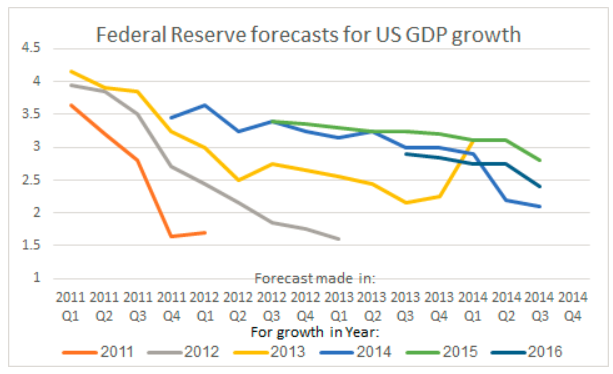
Mish: The economic projections of the Fed have been and remain laughable.

Here is an amusing chart of the Fed's own pathetic performance from Honey I Shrunk the Kids.

.

Yellen: Given this economic outlook and the attendant uncertainty, how is monetary policy likely to evolve over the next few years? Because of the substantial lags in the effects of monetary policy on the economy, we must make policy in a forward-looking manner. Delaying action to tighten monetary policy until employment and inflation are already back to our objectives would risk overheating the economy.

Mish: The Fed is far too late. The obvious bubbles in equities and junk bonds are proof enough. The Fed has never once in history tightened in a forward-looking manner. Panic reactions are the norm.

Yellen: If the economy continues to improve as I expect, I think it will be appropriate at some point this year to take the initial step to raise the federal funds rate target and begin the process of normalizing monetary policy. To support taking this step, however, I will need to see continued improvement in labor market conditions, and I will need to be reasonably confident that inflation will move back to 2 percent over the medium term.

Mish: The idea that consumer price deflation is damaging is downright idiotic. Even the BIS recognizes that fact. For discussion, please see Historical Perspective on CPI Deflations: How Damaging are They?

Fed Consistently Wrong

The Fed has been consistently wrong as discussed in Why Are Economists' Predictions So Damn Awful?

The Fed has been so wrong, so many times, and in so many ways. Why anyone bothers to listen to such speeches other than to poke fun at them remains a mystery.

Mike "Mish" Shedlock
http://globaleconomicanalysis.blogspot.com