الثلاثاء، 6 ديسمبر 2005

Stated Income Fraud

Inman news is asking Is real estate fraud getting the greenlight?
The mortgage industry is getting used to all the Chicken Little warnings about fraud, but few have heard quite the proclamation of virtual surrender recently offered by two high-level individuals involved in the business.

Bruce Morris, executive vice president, quality control, Saxon Mortgage Services, Glen Allen, Va., said deception has advanced so far, so quickly that, "every portfolio in the country has fraudulent loans in it."

Speaking at a Texas Mortgage Bankers Association event in Dallas earlier this month, Morris complained that too many industry members tolerate fraud. "We are our own worst enemies, believe it or not," he said, demanding that "we can't have a tolerance for it, we just can't."

Special Agent Kellee Casebeer of the Dallas Division Field Office, reported that the world transformed for white-collar crime on Sept. 11, 2001. It was the number one priority of the FBI prior to the terrorist attacks in New York and Washington, D.C., on that day. "But afterward, combating white-collar crime became number seven," she said. "All the issues of terrorism moved into those first six slots."

What's worse, Casebeer said, "within white-collar crime, financial institution fraud is number four, and within that is mortgage fraud. So, unfortunately you're number four of number seven," she told mortgage professionals in the audience, drawing some nervous laughter.

The federal law enforcement agent said that "as a result of shifting priorities, at this time, we're not going to be able to expend resources on fighting fraud." Although she invites reports of fraud, the FBI must carefully prioritize cases to pursue and one consideration is whether there will be formal prosecution. Casebeer said: "If the United States Attorney's Office will not prosecute, we won't investigate [cases]."

Further on mortgage fraud, Saxon's Bruce Morris predicted problems "for all of us who made these wonderful [new] loans in California," where 19 percent of all the loans made in 2004 the borrowers would not have qualified for a traditional 30-year mortgage.
Fraud Invited

I have a friend in the industry, Dave Donhoff, a National Mortgage Banker/Broker, and he emailed me his response to that article. Following are his comments:

Fraud is actually INVITED (by default) with Stated Income loan guidelines, and the lender's Account Executives seeking to drive volume (who are being managed and coached, as the article discloses, by their company's principles.) There was a time... a 'hey day' when Stated Income loan programs filled a real need for the self-employed entrepreneur who had more bill-paying revenue at his disposal than his personal taxable revenue reflected. Way back then (what... 25 years ago maybe?) this was an evolution in income documentation methods, following what was then a "make sense" path of reasoning. We're now past that period of time.

TODAY "Stated Income" is completely unnecessary because either income can be verified by a variety of alternative means (bank statement deposits, for example,) OR... if someone truly lives 'cash & carry' there are now a multitude of fraud-resistant No-Income-Claimed document types (No Ratio, No Doc (both with or without asset verification.)) These programs are available at lower credit scores, and higher loan-to-value levels, than old fashioned "Stated Income" loans were "way back in the day" when Stated arrived... AND even though the interest rates on the non-fraudulent loan methods are priced to the relative risks, they are STILL lower than a Full Doc 30 FRM just 20 years ago, so there's really no excuse to commit fraud.

We are at a point in our industry where is is appropriate to ABOLISH all "Stated Income" programs entirely... make them regulatorily illegal entirely (or better yet, exempt lenders from any fraud recourse in law if they fund a Stated Income loan...) as an avoidance of such a fertile ground for larceny.

Today documentation fraud is *ALMOST PURELY* driven by desperate loan officers seeking a commission (hired en-masse by greed-blinded newby principles/owners allowed to drop to the lowest denomator of ethics.) The over-hiring of unqualified sales hacks (often young 1st-time-employees without basic math skills, let alone financial advisory skills) has been driven by a unique combination of unprecendented factors;

A) An environment of firesale interest rates driven down by market forces,
B) A technological breakthrough in automation allowing credit and risk analysis to micro-price loans to a borrower's personal specifics... making it possible to price loans for the riskiest of borrowers without forcing the cleaner borrowers to pay the same rates and fees as their riskier neighbors (thus EVERYONE had a gift dropped in their laps,)
C) Origination technology has superficially eliminated much of the manual/mental process of Origination, such that Loan Officers no longer have to sit face-to-face with a borrower and establish their financial credibility... so the normal consumer demand for that credibility has been relaxed dramatically... thereby opening the door for yesterday's gas-station clerk to become today's so-called "Loan Consultant."

Taken individually, each of these factors is WONDERFUL... however, combined together they've created an environment of degraded ethics in a field where the consumer is very easily lead astray.

Since it is extremely easy to see the direct relationship between documentation fraud and Stated Income loan programs (versus the alternative non-claimed programs,) the answer is to neuter the usage of Stated Income programs.

The FASTEST way (as in snap-of-a-finger) to bring "Stated Income' fraud to a screeching halt is to let all of the secondary market know that (for example,) "As of January 1, 2006, all federally regulated loans must either have all claimed income properly verified with documentation, or have no claim of undocumented income at all. Any loan funded with income claimed and undocumented will be exempt from any recourse to the lender from borrower, originator, and all 3rd party service providers."

No further finger-wagging bureaucracy is required... income fraud will virtually vanish instantly without a single additional dollar of tax-payer funded enforcement.

All the best,
Dave Donhoff
National Mortgage Banker/Broker

The Bottom Line

Here is my take on the matter. Fraud is always rampant at the peak of every market cycle. Stated income loans are fueled by greed and the ability for originators to take the loan, collateralize it, sell it to pension plans and mortgage "investors" willing to accept paltry returns over treasury yields for enormous extra risk.

Those investors or pension plans buying the lower tranches (highest risk slices) of CDO's and CMO's (collateralized debt and mortgage obligations) "backed" (using the word backed loosely) by poor credit risks who are buying houses on non-existent income at the peak of the market are going to have their heads handed to them by the market. The ripple affects will be felt in real estate prices and in pension plans across the country.

Mike Shedlock / Mish
http://globaleconomicanalysis.blogspot.com/

Farm subsidy cuts 'an illusion'

The Guardian is writing that Farm subsidy cuts are 'an illusion' .
Offers by the EU and the US to cut agricultural subsidies are "nothing more than an illusion", according to a new report.

Published by the charity ActionAid, it highlights the negative impact of free trade policies on the Third World. It also claims proposals at the World Trade Organisation's (WTO) meeting in Hong Kong this month could deepen poverty and inequality.

The report, Trade Invaders, shows how imports of subsidised goods from the West are damaging domestic business in poor countries.

"The EU and US claim to have cut their domestic agricultural subsidies over the years but, in reality, there have been no substantial reductions," the executive summary of the document says.

"And despite their recent offers to cut their subsidies, they intend to continue as before by simply taking their subsidies out of one category, or 'box', and reallocating them to another," it continued.

According to ActionAid's estimates, the US pays $25 billion a year in farm subsidies, but current proposals would mean the figure was still at $17-$27 billion.

Similarly, changes put forward by the EU would only reduce its subsidies from 64 billion euros annually to 55-58 billion euros.

"These recent offers are therefore nothing more than an illusion," the report says.
Not only could that $25 billion in subsidies be better spent (as in taken from the budget), we also have to deal with illegal immigrants pouring over our borders to pick some of those crops.

Are Migrant Farmworkers America's New Plantation Workers?

At any rate, the latest trade talks have stalled over crop subsidies. The US and EU want access to emerging markets but do not want emerging markets to interfere with subsidized crops picked by what amounts to slave labor.

It seems to me the status quo is a lose lose proposition, but given the stubbornness of the EU and US, it does not seem likely to change either.

Mike Shedlock / Mish
http://globaleconomicanalysis.blogspot.com/
Brown launches UK's "Ownership Society" as panic sets in

The Guardian is reporting Brown aims for 200,000 new homes per year
The government announced plans for a big house-building programme yesterday in an effort to avoid a looming crisis which threatens to lock huge numbers of would-be homeowners out of the housing market within the next 20 years.

It wants to see up to 200,000 new homes a year in England - an increase of a third on current levels - as it seeks to ensure that up to three out of four people get the chance to become homeowners.

The government argues that there is a choice between a "step change" in housing provision which would match supply and demand, and the social and economic damage caused by unaffordable housing.

It is backing its homes-building strategy with a series of measures including help for first-time buyers, a streamlined planning process and legislation for real estate investment funds that will increase the money available for housing development. It is also considering a windfall tax on landowners' profits when they get planning permission for developments to help pay for the infrastructure in new communities.

But the plans were criticised by housebuilders who said a windfall tax would strangle development and also from green campaigners worried about the impact on the environment.

In his pre-budget speech Gordon Brown said that though there were now more than one million more homeowners than in 1997 Britain still needed to bridge the gap between the numbers of homes being built and the rate at which new households were being created. He drew particular attention to the need "to build houses young people can afford". Investment in social housing, which has doubled since 1997, is set to rise further, he said

In a joint announcement giving more details, Mr. Brown and the deputy prime minister, John Prescott, said: "The choice is clear: meet the needs of future generations or deny them the opportunities we enjoy. Extend the benefits of home ownership towards 75% of households or accept that unaffordable housing will constrain our social and economic ambitions. Support affordable housing or see growing inequalities and disadvantages."

Yvette Cooper, the housing and planning minister, said later current house-building levels were running below those at the end of the second world war and the 1980s. "The evidence is clear - if we fail to increase the number of new homes then within 20 years less than a third of30-something couples will be able to afford to buy a home of their own," she said.

Mr. Brown also gave more details of plans for more affordable homes. He said he had struck a deal with three leading mortgage lenders which would mean home-buyers only need to take out a mortgage for 75% of the property's value, with the lender and the government sharing the rest of the cost.

One of the most controversial parts of the government's housing package is the decision to consult on a windfall tax on profits on land granted planning permission. According to the government's figures agricultural land in England has a market price of £9,280 per hectare while industrial and warehouse sites sell for about £632,000. That compares with the price of land with planning permission for new houses of some £2.46m per hectare.

Mr. Brown said he would be consulting on "proposals for a local planning gain supplement to give local authorities a fair share of planning gains to invest locally".

But Philip Davies, chief executive of Linden Homes said: "With Britain in the grip of a housing crisis, the implementation of a planning gain supplement ... would only further strangle housing supply in the UK."

Clare Hartnell, a tax partner at Grant Thornton, said historically such schemes had proved unsuccessful.

"The key is the rate at which PSG will be levied." she said.
Can someone please tell me why it is the role of government anywhere to make sure people own houses? Are renters second class citizens? Why should the government care if someone owns a house or if someone rents a house? Besides, who really owns a house anyway? The only way many people can afford a house is by taking out an interest only loan for 30 years. How many people expect to be able to pay off their mortgages completely? Heck, most of the advice I see says you are a sucker to do that. In fact, one of the reasons housing is not affordable is because of silly governmental programs designed to make "housing affordable". The US has 280 such programs in addition to Fannie Mae and Freddie Mac. Are these programs working or are they part of the problem?

Actually I do not think affordable housing is what is REALLY on Brown's mind at all. Quite frankly I think he is scared half to death of an impeding economic collapse and is looking for anything and everything to make his silly budget projections look better. I offer the following as proof:

Stephen King is reporting Brown's goalposts have not just been shifted, but moved into a different stadium.
The Chancellor is seriously short of revenues, a shortage that has both persuaded him to launch a raid on oil companies and circumscribed his room for policy action.

His problems, though, run deeper than a simple revenue shortfall. His whole framework is creaking under pressure from events beyond his control. Because of this, he is shifting the goalposts in ways that undermine the credibility of his "golden rule", the lodestar for his fiscal decisions.

The possibility that wages are weak because of global competitive pressures rather than weakness of domestic demand could easily come back to haunt Mr Brown.

All economists have problems measuring the output gap, so the Chancellor's decision to shift the goalposts is hardly a heinous crime. On closer inspection, though, it appears that the goalposts have not just been shifted a little way across the pitch: rather, they've been sent off to an entirely different economic stadium.

Over the summer, the Chancellor decided, on the basis of revised output data, that the latest economic cycle began in 1997. Up until then, the Chancellor had argued that the cycle began in 1999. The advantage of this redefinition is obvious: it provided the Chancellor with a couple of extra budget surplus years, thereby increasing his chances of meeting his golden rule over the course of the - now-lengthened - economic cycle. In yesterday's report, he went a stage further.

In the March Budget, Mr. Brown's numbers suggested that the current economic cycle would come to an end in 2006-07. He's now suggesting that the cycle will come to an end in 2009-10. This decision - seemingly innocuous but hugely influential on his ability to meet his fiscal rules - gives him a few extra years in which to make up the revenue shortfalls that have left his budgetary coffers so short of cash.

I have no idea of where we'll be cyclically at that stage. Neither has the Treasury. And nor has the Chancellor. But it's a neat trick: rules, it seems, are there to be bent, if not broken.

The contradictions within the report reveal a chancellor who is no longer enjoying an easy economic ride. He wants to argue that growth has not been as weak as the official numbers suggest. He wants to argue that the output gap is bigger than previously thought. He wants to argue that the labour market is benefiting from supply-side flexibility. And he wants to argue that the economic cycle will continue for another three years relative to the projections made nine months ago. On some of these observations, he may be right. It is highly unlikely, though, that he'll be right on all of them.
Gordon Brown is clearly in a panic.
His bragging about the "Golden Rule" is about to come back and haunt him as he is now hoping that some sort of miracle silver bullet can be found in housing. Bear in mind this is the man that sold a huge chunk of England's gold at $250/oz marking the bear market bottom. Did he think gold was going to zero?

Brown's troubles are just beginning. The North Sea has peaked and sometime soon the UK will be an importer of oil. His economic cycle was revised from 1999 to 1997 on the back end and now he is revising the cycle end from 2006-2007 to 2009-2010. That is not enough it seems and his panic proves it.

I have some advice for Gordon Brown.
Bush, Snow, Greenspan and Bernanke can use the same advice.
  • Let the market set interest rates
  • Get back on the gold standard
  • Stop spending more than you take in
  • Get out of the "affordable housing" business
  • Let the market resolve economic cycles instead of you trying to dictate them
Mike Shedlock / Mish
http://globaleconomicanalysis.blogspot.com/
الاثنين، 5 ديسمبر 2005

Washtenaw - The Opening Salvo?

In what may only be the opening salvo Washtenaw Seizes Up/
Washtenaw said it decided Dec. 2 to discontinue mortgage loan production operations due to the termination of the agreement with Genstone, its inability to satisfy closing conditions on its warehouse facility, as well as adverse business conditions.

The company said that it has been impacted by rising interest rates, the subsequent declining demand for new loans, further downward pricing pressure on net sales revenue and continuing mortgage loan repurchases. It will therefore not originate any new loans, effective immediately, and the remaining loans owned by the company are expected to be sold to investors within approximately 30 days.

Washtenaw said it will lay off all employees involved in the origination of new loan production immediately, and it does not know whether or not it will be able to pay those employees severance.
OK who is next?
If nothing else, expect a lot of layoffs and hard times ahead for mortgage loan originators, real estate agents, and title insurance companies.

Mike Shedlock / Mish
http://globaleconomicanalysis.blogspot.com/

Quick Death for Tax Reform

Bloomberg is reporting Bush to Delay Major Push for Tax Overhaul.
President George W. Bush will delay a major push for revamping the tax code because administration officials concluded the changes are too tough to sell to the public and lawmakers, two people familiar with the matter said.

Bush instead will spend next year attempting to lay the political groundwork for fundamental changes in 2007 or 2008, the people said, and leave to Congress the task of tackling incremental tax code simplification in 2006, an election year.

The administration is wary of seeing its push to overhaul the tax system fall prey to the same factors that derailed Bush's attempt to restructure the Social Security system this year to include private investment accounts: negative public reaction and a Congress focused on the Iraq war and rebuilding the U.S. Gulf Coast from two hurricanes.

Postponing the tax changes would leave Bush without a focal point for next year's domestic agenda at the same time his Republican Party is attempting to maintain its majorities in the House and Senate. Other initiatives, such as making permanent the income tax cuts enacted during his first term and key parts of his energy plan, also are hanging in balance.

Learning from the battle over Social Security, the president may use the next year to generate public and congressional support for changing the tax code by stressing simplification and fairness, said a Republican who worked on the tax overhaul plans and spoke on the condition of anonymity.

The person and an administration official, who also spoke on the condition of not being identified, confirmed a story published yesterday by Time magazine that major tax changes likely will be put off until 2007 or 2008.

Bush hasn't mentioned tax code changes since his Advisory Panel on Federal Tax Reform issued a 272-page report Nov. 1 recommending two ways to overhaul the tax code. The proposals would reduce or eliminate many popular deductions such as those for mortgage interest and state and local taxes while reducing taxes on investment and abolishing the alternative minimum tax.

The silence stands in contrast to the fanfare with which the president announced the panel's creation in January. Then, Bush introduced panel Chairman Connie Mack, a former Republican Senator, and Vice Chairman John Breaux, a former Democratic Senator, in a ceremony at the White House.

Critical Reviews

While Mack, Breaux and the rest of the nine-member panel argue their recommendations as a whole wouldn't dramatically shift tax burdens, the proposals have been criticized by groups such as the National Association of Realtors, the American Council of Life Insurers and the Bond Market Association, which say tax breaks important to the interests they represent may be at risk.

The biggest flashpoints of the panel's recommendations are proposed changes to mortgage interest deductions. The proposals would restructure housing tax incentives now concentrated among higher-income people. No tax benefit would be permitted for interest on a mortgage of more than $412,000; the cap would be as low as $227,000 in some areas with cheaper housing. Current law allows a deduction for interest paid on mortgages up to $1 million for primary mortgages and $100,000 more for home equity loans.

Surveys and focus groups conducted for the Bush administration on overhauling the tax code found some enthusiasm until details such as altering the mortgage deduction were mentioned and began to draw objections, according to the person who has worked with the administration.

Bigger Changes

Some Republicans in Congress, including former House Majority Leader Tom DeLay of Texas and Senator Jim DeMint of South Carolina, have criticized the panel's work for not concluding a more radical overhaul is necessary. DeMint is proposing a tax code that would raise revenue from a 8.5 percent national sales tax and a 8.5 percent European-style value-added tax on businesses while eliminating income taxes.

Postponing the tax-overhaul proposal until 2007 will give the administration time to build consensus around a plan, said Clinton Stretch, director of tax policy at Deloitte & Touche LLP in New York. Stretch said that while he had not heard about plans to delay the tax changes, he's not surprised.
Flashback 2004

Two days after the election, in a press conference on November 4, 2004 president Bush said:

"Let me put it to you this way: I earned capital in the campaign, political capital, and now I intend to spend it. It is my style. That's what happened in the -- after the 2000 election, I earned some capital. I've earned capital in this election -- and I'm going to spend it."

Has anyone in history used up political capital so quickly with nothing to show for it?
  • Social Security Reform - Dead On Arrival
  • Tax Reform - Never got out of the gate
  • Torture - Bush and Cheney split with McCain and openly support torture
  • Iraq - Bush plan to "stay the course" is failing
  • Immigration Reform - Republican infighting
  • Polls - Bush support at 35% or so
One year in his second term and Bush is already the lamest of lame ducks.

There are of course two ways to look at this.
1) Tax reform is desperately needed and something has to be done about the AMT.
2) Tax reform may be needed but whatever Congress does will likely make matters worse. The best thing that can happen is nothing.

I was hoping for tax reform actually and thought the President's panel did a decent job with its recommendations. I would rather have seen a flat tax proposal but sensing that would be DOA I thought the recommendations were at least a start in the right direction. It seems that killing any part of the mortgage deduction just will not fly.

Apparently Bush does not have enough capital left to get anything done. Where did that capital go? The answer is out the window with a failed strategy in Iraq and a public that is just plain fed up with it.

We really do need tax reform, but like balance of trade, spending cuts, pension liabilities, trade agreements, deficit spending, the national debt, crop subsidies, health care costs.....

Once again, it looks like it's next year’s business.
So much for "Political Capital".

Mike Shedlock / Mish
http://globaleconomicanalysis.blogspot.com/

الأحد، 4 ديسمبر 2005

Are GSEs now in Prayer?

Freddie Mac is reporting a foreclosure suspension valid thru February 28th, 2006.
McLean, VA – Freddie Mac is extending through February 28, 2006 its foreclosure suspension on mortgages on homes in Hurricane Katrina and Rita disaster areas and adopting other policies so servicers can continue to extend "the highest level of understanding" to storm victims seeking to extend the mortgage payment suspension period that expires today December 1, says a November 30 policy Bulletin issued by the company. The new Bulletin only applies to Freddie Mac-owned loans on homes in major disaster areas designated by FEMA as qualifying for individual assistance.

The mandatory forbearance and foreclosure suspensions adopted after Hurricanes Katrina and Rita have helped several thousand borrowers cope with the aftermath of the two storms.
Mish translation:
Freddie Mac is scared to death about bankruptcies and write-offs related to Katrina and Rita. As long as Freddie Mac can avoid write-offs of the obvious, they might be able to prolong the agony. Perhaps in the meantime the US government will make good on all outstanding loans in the hurricane areas. I doubt it, but perhaps that is the prayer.

In other news Freddie Mac Increases Common Stock Dividend by 34 Percent.
The board of directors of Freddie Mac today declared a $0.47 per share quarterly dividend on the company's voting common stock, a $0.12, or 34 percent, increase in the quarterly dividend. In addition, the company provided an update on financial trends and business performance for the third quarter of 2005. The common stock dividend action is the third increase in two years, with a cumulative dividend increase of approximately 81 percent since December 2003.
One can only wonder if Freddie is delusional or if this is some kind of ploy related to the above prayers. A 34% increase in dividend yield "sounds" spectacular until one sees that this dramatic increase will still leave the yield shy of 3%.

Wasn't there a time when dividend yields really mattered?
Oh well, that was so long ago that no one cares now.
Now we care about growth regardless of how expensive it might be.
Unfortunately the FED is still trying to rein in growth of GSEs.
Does anyone remember that?
One might also note that one can get over 4% guaranteed on 6 month treasuries without worrying about whether or not the GSEs will implode.

If you buy Freddie Mac based on this dividend yield increase, I suggest you do what they are doing. Pray.

Mike Shedlock / Mish
http://globaleconomicanalysis.blogspot.com/

Timing the Credit Event

Back in September we asked: Are we headed for a "credit derivatives event"?

We pointed out what Saxon Capital was saying in an earnings conference call.
Here are the key points:
  • "At the point in time WHEN the credit event comes, AND IT WILL we will be very well placed to take advantage of what happens next"
  • "I am concerned about the level of capital" of our competitors "to service the bonds as those portfolios age"
  • "Should real estate on the west coast flatten out I would be worried about a credit event"
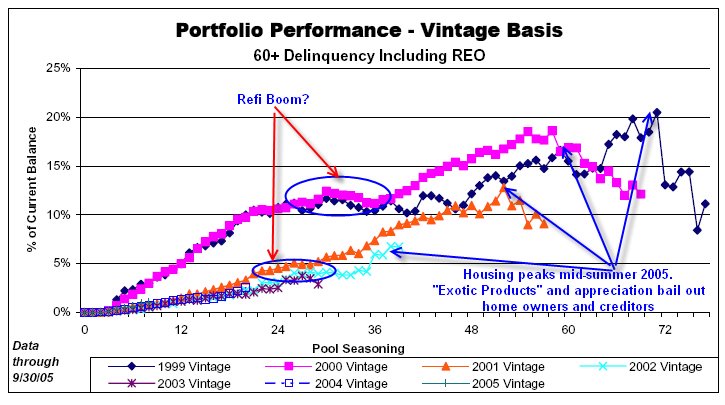
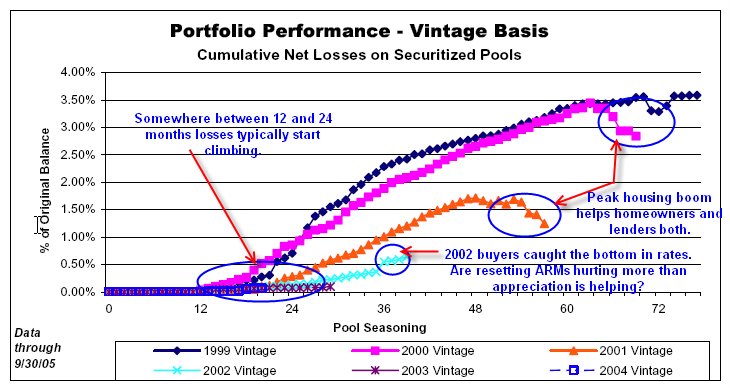
Let's now take a look at the Portfolio Performance of Accredited Home Lenders Holding Co. (LEND). Following are the relevant charts annotated by me.

(Click on any chart for an expanded view).


The following chart is courtesy of Yardeni, with Mish annotations.


It should be clear from the above charts that a boom in refis at lower rates may have helped stall rising delinquencies and loan losses.

Also note how 2002 stands out from all other years on the second chart. For 2002 there was no dip in delinquencies or loan losses corresponding to the blowoff top in housing. Is this related to the fact that ARM loans from 2002 are now resetting? Remember too that anyone that took out an interest only loan near the lows has now suffered thru 12 consecutive rate hikes. $500 minimum monthly payments are now close to $850. Does that matter? I think so, and savings rates that have now gone negative may offer some proof.

The 2003 and 2004 loans are the ones to watch. With home prices stalling, and even declining in some key areas it may not be possible to refi even IF rates drop. In that regard a good guess is those purple question marks on the second chart resolve lower regardless of what rates do. Two more hikes and this economy is likely in deep trouble.

Back on November 15th, we looked at Bank Lending Practices .

Let's review a chart and some text from that blog.


Some time within the next year 60% of all of the outstanding subprime adjustable loans are going to reset. This is going to be a rude awakening to many who will see monthly mortgage payments skyrocket. Worse yet, given rising inventories and falling or stagnant home prices it is going to be hard to sell.

Right now it does not seem to matter. That is the way it always is. Nothing matters until it matters, and the corollary is that it never matters until the bitter end. Right now it seems that the fat lady is singing but few hear the tune.


Considering all of above, it seems likely that both a credit event (spawned by collapsing housing prices) and a recession are in the cards for 2006. The more hikes the FED gets in now, the more hikes the FED will be taking back in 2007.

Mike Shedlock / Mish
http://globaleconomicanalysis.blogspot.com/