الاثنين، 14 نوفمبر 2005

Bank Lending Practices

The October 2005 Federal Reserve Survey on Bank Lending Practices shows that most banks still haven't altered lending standards for home equity lines of credit even after the FED raised concerns about whether lenders were adequately weighing risks.

The report shows domestic commercial banks reported a further net easing of lending standards and terms over the past three months.

In response to the special question about changes in terms on mortgage loans to purchase homes, notable net fractions of domestic institutions reported that over the past two years they had eased a number of terms, including the maximum size of primary and second mortgages, spreads of mortgage rates over an appropriate market base rate, and the maximum loan-to-value ratio.

Here are some highlights of the survey:
  • Nearly 10 percent of respondents, on net, reported having eased their credit standards on loans to large and middle-market firms.
  • About 30 percent of domestic respondents reported that they had reduced the costs of credit lines in October.
  • Almost all domestic banks that reported having eased their lending standards and terms in the October survey cited more-aggressive competition from other banks or nonbank lenders as an important reason for doing so
  • Almost 40 percent of domestic banks, on net, reported that over the past two years they had increased the maximum size of primary mortgages they were willing to provide.
  • About 30 percent, on net, indicated that over the same period they had increased the maximum size of second mortgages.
According to CFC October 2005 Operational Results, it seems that Countrywide Financial is one of the purveyors of the yet still looser bank lending practices that the regulators are talking about. Here are the highlights:
  • Adjustable-rate loan fundings for the month were $23 billion, up 42 percent from October 2004. Year-to-date adjustable-rate fundings totaled $214 billion.
  • Nonprime loan fundings totaled $3.9 billion in October, which compares to $3.3 billion for the same period last year. Year-to-date nonprime fundings were $36 billion.
  • Pay-option fundings for the month were $8.5 billion, as compared to $3.4 billion in October 2004.
  • Interest-only loan volume was $8.9 billion for the month of October 2005, which compares to $5.9 billion, for the same period a year ago.
The most amazing of those statistics is the rampant increase of "pay-option loans" smack in the face of flattening or declining home prices and a FED that seems bound and determined to break the housing bubble by hiking interest rates.

The LA Times recently discussed The hidden perils of pay-option loans. Let's take a look.
Borrowers with dangerous adjustable rate mortgages that give them the option of paying just about any way they like may find the loans even more perilous — and more expensive — than they ever imagined.

For starters, borrowers may find that as the rates on their mortgages adjust, they could be paying as many as three or four percentage points more than they would had they chosen a different type of adjustable mortgage.

Perhaps even worse, once borrowers realize they acted unwisely, they may not be able to get out of their loans without paying a hefty penalty. Even if you sell your house, you could be required to pay a prepayment fee totaling six months' interest to terminate the mortgage.

In exchange for all this, the broker who put his client in this precarious position is getting paid three times as much as he would had he placed the borrower in a more consumer-friendly adjustable mortgage.

Typically, lenders who actually fund the mortgage pay brokers a half-point — 0.5% of the loan balance — when they bring in borrowers who want a so-called payment-option ARM. But if the loan carries a prepayment penalty, they'll pay the broker a larger incentive.

These kinds of extreme charges are not attached to any mortgage other than pay-option ARMs, a loan that allows the borrower to choose from four different payment options each month.

Borrowers can pay the absolute minimum as calculated by a complicated formula. They can make an interest-only payment based on the fully indexed rate but with nothing going toward the outstanding balance. Or they can make a full interest and principal payment based on either a 15- or 30-year payment schedule.

Borrowers are drawn to pay-option ARMs because of their 1% start rate. But what they often don't realize — and sometimes aren't being told — is that while their payment doesn't change for a year, the rate starts adjusting after the first 30 days.

Of course, with these loans, the payment doesn't change until after 12 months. But because the rate moves on a monthly basis, the result is what's known as "negative amortization." That means that whatever the difference between what you pay and what you owe is added to the loan balance.

For pushing such an unfriendly loan on uninformed borrowers, mortgage brokers are paid handsomely, as are loan reps who work for lenders themselves.

"The kind of stuff going on out there is wrong," says Mitch Ohlbaum, a West Hollywood mortgage broker. "I think these loans work well when explained and priced properly. The problem is that no one is educating borrowers on what they are getting into."

A regular person with a regular job will fall behind very quickly if he makes interest-only payments. "People who know what they make each month have no business in a loan like this. They will get demolished."
Mish, is that what this is all about: greed on behalf of the lender and stupidity on behalf of the borrower? That seems likely but it really is impossible to say. Perhaps it is more like stupidity on behalf of both the lender and borrower to be taking risks like this at the pinnacle of this bubble in the face of repeated FED warnings. At any rate please remember the excuse the lemmings gave in the survey before they followed each other off the cliff: "Almost all domestic banks that reported having eased their lending standards and terms in the October survey cited more-aggressive competition from other banks or nonbank lenders as an important reason for doing so."

What this most assuredly boils down to is:
  • Fear of losing a deal
  • Desire to increase market share or "make the numbers" regardless of risk
  • Plain out and out greed
  • Belief that Greenspan (or Bernanke) will bail them out if anything goes wrong
Mish, how rampant is this nonsense? That is a good question and enquiring readers might make note of the fact that in bubble areas such as California, 28% of new mortgages in the first half of 2005 were subprime vs. 5% in 2000. 42% of first time buyers made no down payment on their home, and over a third devoted at least 33% of the incomes to mortgage payment.

It seems like this is starting to matter right now, but even if not, it is going to matter sooner rather than later. Much sooner in fact, as evidenced by this chart.


Some time within the next year 60% of all of the outstanding subprime adjustable loans are going to reset. This is going to be a rude awakening to many who will see monthly mortgage payments skyrocket. Worse yet, given rising inventories and falling or stagnant home prices it is going to be hard to sell.

Right now it does not seem to matter. That is the way it always is. Nothing matters until it matters, and the corollary is that it never matters until the bitter end. Right now it seems that the fat lady is singing but few hear the tune.

Mish, Saxon Capital just reported, what did they have to say?
That is a good question so let's take a look.

Saxon Capital, Inc. Reports Third Quarter 2005 Operating Results .

"During the third quarter, we continued to see the unfavorable market conditions that we discussed in the second quarter", said Michael L. Sawyer, Chief Executive Officer of Saxon. "The continued rise in short-term interest rates, and accelerated prepayment speeds, coupled with the extended period of muted market pricing increases continue to adversely effect our results. We remain committed to prudent management through these times, concentrating on reducing general and administrative expenses, growing our centralized retail origination platform, focusing on capital preservation, and ensuring a strong balance sheet."

Well so much for honesty as the following chart shows.


Is Saxon being punished for honesty while CFC is taking on more risk?
Unfortunately I have no answer to that question other than perhaps CFC's day of reckoning is coming.

Mish readers might recall that we previously discussed Saxon Capital in Are we headed for a "credit derivatives event"?

In their last conference call Saxon was saying:
  • "At the point in time WHEN the credit event comes, AND IT WILL we will be very well placed to take advantage of what happens next"
  • "I am concerned about the level of capital" of our competitors "to service the bonds as those portfolios age"
It seems to me, based on the above chart, that the market is more worried about a "Credit Event" at Saxon than its competitors.

Meanwhile, from The Economist Global Agenda, Buttonwood is asking With a pfffffffft or a fizzle?
What could give this scenario an uglier twist is the sharp increase in funny loans to funny borrowers over the past few years. “Subprime lending” to people who would not normally be able to make the grade is running at about $500 billion a year. Much of it takes the form of variable-rate, interest-only and negative-amortisation loans. Both debtors and creditors are now more exposed to interest-rate changes.

Banks have been happy to lend to marginal debtors, safe in the knowledge that they could unload many of the loans either on one of the quasi-governmental housing agencies (Fannie Mae, Freddie Mac) or to private investors in asset-backed securities. Many of these loans end up in collateralised debt obligations (CDOs, which slice up bundles of referenced loans into tranches of different riskiness for different investors). Japanese and European investors have been especially enthusiastic buyers of this sort of paper, but there are signs of battle fatigue now: spreads have widened sharply over the past couple of weeks.
Indeed. Hot potato is the name of the game.
Take what you can when you can and pass the trash if you can.

Can this go on forever?
Not likely if the following headline is the start of any kind of trend:
Swiss pension fund shifting away from U.S.
Switzerland's $15.5 billion state pension fund plans to reduce its investment in U.S. bonds and dollar-denominated debt because of concern that rising U.S. government debt and interest rates may hurt the U.S. economy.

Higher market interest rates could lead to defaults on loans by homeowners and affect mortgage finance companies including Fannie Mae and Freddie Mac, Eric Breval, managing director of the Swiss pension fund, said during a recent interview in Geneva. Assets will be shifted into euro-denominated bonds, he said.

U.S. government debt stands at a record, and Congress has increased its scrutiny of Fannie Mae and Freddie Mac amid concern that their debt may be too large, posing risks for the economy. Together, the two companies own or guarantee almost half of the $7.6 trillion U.S. mortgage market.

"There is a greater risk in the U.S. than elsewhere," Breval said. "When you see some institutions such as Fannie Mae and Freddie Mac and the time bomb they are sitting on, something may happen there one day, and we want to be less exposed."
Fannie Mae is a "time bomb".
I couldn't have said that better myself.
But the party continues. Right now money is still flowing into stocks and the market seems bound and determined to have a year end party. Who am I to argue? All I can say is that it will be one hell of a hangover when the party ends.

Mike Shedlock / Mish
http://globaleconomicanalysis.blogspot.com/

الأحد، 13 نوفمبر 2005

Outsourcing Lawyers

India Times is reporting that Indian offshore firms are courting lawyers.
Let's take a look:
Close to the rugged farmlands of Haryana near Delhi, dozens of shirt-sleeved graduates are busy at work in an office park. Much of this work at a firm called Evalueserve in the town of Gurgaon is the same as is done thousands of miles away in wood-panelled Manhattan law offices by young attorneys, some of whom command six-figure dollar salaries. Although Indian lawyers cannot argue in a U.S. court, local start-ups reckon they can take on much of the legal back-office burden, such as filing patents that mix high technology and U.S. law -- the latest in the outsourcing wave that uses high-speed telecoms and low-wage, English-speaking Indians to save Western firms hundreds of millions of dollars a year. "The only thing that can't be outsourced to India is something that requires physical presence," said Sanjay Kamlani, co-founder of Pangea3, a firm employing 23 lawyers in India and five in the United States, plus technical engineers. Kamlani insists that training Indians for U.S. law is easy. "Both the U.S. and India were British colonies and common law is British," said the U.S.-based lawyer of Indian origin whose firm has 20 clients helping in legal document management, contract drafting, legal research and patent filing. According to India's National Association of Software and Service Companies (NASSCOM), India has so far tapped only 2-3 percent of an estimated $3-$4 billion U.S. market of "outsourceable" legal services.
One by one white collar jobs are following blue collar jobs to India and China. The following quote sums up the situation nicely: "The only thing that can't be outsourced to India is something that requires physical presence". In the meantime even jobs that do require physical presence do not necessarily go to US citizens.

The St. Petersburg Times is taking a look at Who's rebuilding New Orleans?
Locals angrily point out migrant workers, saying they're taking jobs to the exclusion of residents who can't afford to come home.

As military helicopters thumped overhead, R.J. Rouzan paced and waved his arms inside an office in City Hall.

National Guard troops that morning last week had blocked him from visiting his property in the Lower 9th Ward. Something to do with needing a permit. City officials didn't know what he was talking about.

Then, in the middle of an argument that seemed to be about red tape, Rouzan veered suddenly toward a subject that has angered many local residents.

"They let trucks full of illegal aliens in there and not the property owners?" Rouzan yelled at a weary-looking receptionist.

Immigrant workers - some in the country illegally - have been pouring into New Orleans since Hurricane Katrina devastated the city.

While no one knows how many Hispanic workers are in New Orleans, teams of Mexican and Central American laborers drawn from around the United States appear throughout the city. Wearing white protective suits and yellow boots, they pressure wash mold-infested rooms, tear out Sheetrock, rip down soaked insulation and empty rotten shrimp from refrigerators.

Rouzan, a black owner of construction and trucking businesses, said his employees are scattered across several states. Without a place to stay, they can't come back to work. Watching Hispanic workers take similar jobs, Rouzan seethes.

"They are allowing people to come in who are getting jobs while we as homeowners who built this city, they don't let us get access to our property," Rouzan said.
At some point there is going to be a huge backlash over the loss of jobs.
You can see it coming and you can feel the heightened protectionism that will likely come of it.

Mike Shedlock / Mish
http://globaleconomicanalysis.blogspot.com/
الخميس، 10 نوفمبر 2005

Investors Warned by JPM

The headline reads: Investors warned of stock bubble.

What is interesting to me is not that it is being said but who is saying it and most importantly no one is listening. Here are some comments by Jonathan Golub, New York-based managing director and U.S. equity strategist for JPMorgan Asset Management speaking before a group of about 50 clients and business leaders at Nonna's Euro American Ristorante:
  • There's no real estate market in the nation that's beat the stock market in the last three years. Investors don't recognize the nearly unprecedented three-year surge in stocks because most are 'mentally anchored' to March 2000, the top of the tech-driven market.
  • Americans, many of whom "feel wealthy" because of the growing value of their homes, are spending more than they make.
  • The riskier the company, the junkier the company, the worse your management was, the better your return was. "Why? Because when you put free money in the system, junk rises to the top."
  • Prudent investors should seek quality companies with strong earnings, dividends, good business plans and solid management. More traditional investments should be in favor "not just for the next six months, but for the next two to three years."
  • Something must curb the level of consumer spending, and it likely will have to be something drastic
  • "I don't see something that's going to quietly burst this bubble. I frankly thought it was going to be (hurricane) Katrina. ... But Americans shrugged that off like it was a little storm. That was shocking."
Indeed. Junk for the most part has risen to the top.
Furthermore, in spite of a warning bell that was rung by TOLL and accompanied by a choir of rising rates from the FED, it seems that everyone is deaf. Apparently there is still just too much money sloshing around right now that needs to be destroyed before anyone pays attention.

Mike Shedlock / Mish
http://globaleconomicanalysis.blogspot.com/
الأربعاء، 9 نوفمبر 2005

Trade Summit Fails

The trade summit in Argentina ended in complete failure. The lofty goal was to open a free trade zone stretching from Alaska to Chile. The summit ended without even so much as an agreement to restart the failed talks at a later date.
Argentine Foreign Minister Rafael Bielsa said the summit's declaration would state two opposing views: one favoring the proposed Free Trade Area of the Americas and the other saying discussions should wait until after World Trade Organization talks next month.

Mexico, the United States and 27 other nations wanted to set an April deadline for talks, but that was opposed by Brazil, Argentina, Uruguay, Paraguay and Venezuela.

The United States says the Free Trade Area of the Americas, stretching from Canada to Chile, would open up new markets for Americans and bring wealth and jobs to Latin America. The zone's main opponent, Venezuelan leader Hugo Chavez, says it would enslave Latin American workers.
The Wall Street Journal is reporting Failed Summit Casts Shadow On Global Trade Talks.
A failed summit of leaders of the Western Hemisphere dealt a blow to global trade liberalization and strengthened the influence of Venezuelan President Hugo Chavez, a critic of the U.S. who favors protectionism and old-style socialism.

The Bush administration had hoped to use the meeting of 34 heads of state to breathe new life into negotiations on a long-stalled Free Trade Area of the Americas, a free-trade zone reaching from Alaska to Tierra del Fuego, Argentina. Instead, the meeting was so wracked by division that diplomats drafting the final communiqué failed to reach agreement even on when to resume talks on the free-trade zone.

In handing Washington an embarrassing defeat, Venezuela was joined by the four countries of the Mercosur trading bloc, a customs union led by Brazil and Argentina and also including Paraguay and Uruguay. "We were five musketeers, kneeling, sword in hand," to oppose the FTAA, Mr. Chavez said afterward. He condemned the U.S. free-trade model as a "perversion" that would unduly benefit the U.S., and instead pushed for closer trade ties among Latin American nations.

On Friday, the first day of the summit, Mr. Chavez had given the keynote address at a peaceful rally condemning FTAA and President Bush's policy in Iraq. Later that evening, protests against the trade pact turned violent, with groups of demonstrators vandalizing businesses in downtown Mar del Plata.

The summit confirms the Venezuelan as heir apparent to Fidel Castro as Washington's prime nemesis in its home hemisphere. Mr. Chavez favors heavy state involvement in the economy, and many Venezuelans fear he intends to impose a Cuban-style economic model. He has sharply increased government control over his country's all-important oil industry, forcing foreign oil companies to accept a majority government role in their local ventures. He also has seized what his government considers "idle" farmland from large rural estates and given workers in some factories an ownership stake and management voice.
It’s easy to bash a moonbat and make no mistake about it, Chavez is indeed a moonbat. However, attempting lay blame on Chavez for single handedly wrecking a trade summit is a cop out. Yes Chavez is gloating but he really is not the one who should be taking the "credit, or the blame for these failed talks. Before we can properly lay blame, we must understand what all this bickering is about.

The heart of the matter is agricultural subsidies. Developing nations, seeking to boost their exports, want the U.S. and EU to slash agricultural subsidies. Wealthy nations want poorer ones to slash tariffs, open their service industries to foreign competition and strengthen intellectual-property protection. The poor nations blocked the last major round of talks in Cancún, Mexico, two years ago, because of concern that agricultural subsidies weren't being addressed sufficiently.

Two years have passed and we are no closer to resolving the impasse than we were before. Who is really to blame? Here are the culprits in order. Drum roll please.........
  1. France
  2. USA
This is not about Chavez favoring protectionism and old-style socialism as the Wall Street Journal suggests. It is about the willingness of countries to give up something to get something in return. Developing nations have little to gain by giving in to the current “offer”. Their biggest potential exports for many developing countries are agricultural, but they can not compete when the US and EU are unwilling to open up their markets. In other words, the US and Europe want access to emerging markets but are unwilling to give up anything in return. Yes the EU has agreed to "some" cuts in agricultural subsidies but not enough to please anyone, including France who is not happy about giving up anything at all. Meanwhile, the US is attempting to look like the good guy by "offering" to substantially cut back farm subsidies "IF the EU does" knowing full well that France will never give in on the issue. If the US was really interested in trade agreements it would be a leader instead of waiting for France to act, and it would be willing to phase out subsidies completely not partially. On that note it seems another telepathic question just came in: "Mish, are you sure France will never give in?" Well “never” is a long time but for now I am quite sure.

France Threatens to Torpedo World Trade Agreements.
France will not approve any global trade deal that challenges a 2003 reform of the European Union's common agricultural policy (CAP), Foreign Minister Philippe Douste-Blazy said in a newspaper interview released on Monday.

"Nobody can have any doubt about France's determination not to approve, in Hong Kong, in December, an accord that challenges the CAP as reformed in 2003," Douste-Blazy said told Les Echos newspaper in an interview to run in its Tuesday edition.

French President Jacques Chirac warned EU leaders last month he was ready to torpedo a World Trade Organization (WTO) deal if it called into question the CAP, of which France is the biggest beneficiary.
France is also bickering with the UK over the "budget rebate".

For those that want to understand more about the "budget rebate", what it is, why it was put in place and how France and the UK are at the center of this trade issue, here is a Q&A on the UK budget rebate.

Currently, France is insisting that the rebate be dropped. The UK is quite willing if France is willing to remove the "imbalances" which led to the creation of the rebate in the first place. In other words: the UK wants France to give up its agricultural subsidies. Of course we know where that debate is heading: nowhere (as noted by this headline).

UK's Straw says EU must tackle rebate, farm spending in tandem.
UK foreign secretary Jack Straw, whose country holds the rotating EU presidency, said Europe must tackle Britain's budget rebate and farm spending in tandem.

"The prime minister and I have made it quite clear that we are happy to talk about the rebate, but it's a question of reforming the budget," Straw said on his way into a meeting of EU foreign ministers which will hold the first detailed debate on the bloc's future spending since talks broke down amid acrimony between France and the UK in June.

"The reason the rebate was justified was because of the distorted nature of the budget. So we have to deal with them both," he said.
The US has already shown its true colors on "free trade" in disputes with Canada over Lumber as previously discussed in US misses softwood deadline.
The United States missed a key deadline yesterday for complying with a NAFTA ruling that should have dramatically cut duties in the bitter softwood dispute, denying Canada the gesture of good faith it's been requesting before it would resume talks to settle the conflict.

Yesterday's foot-dragging especially angered Ottawa because it was only on Monday that Prime Minister Paul Martin called on U.S. Secretary of State Condoleezza Rice to provide proof that Washington still respects the North American free-trade agreement.

Canadian-U.S. relations concerning the $8-billion softwood dispute have been in a downward spiral since August, when Washington spurned a different NAFTA ruling that should have ended the conflict.

In this separate case, a NAFTA panel of trade adjudicators has ruled five times -- most recently Oct. 5 -- that the United States's calculation of part of its softwood duties was illegal under U.S. law and it has five times urged Washington to bring its results into line.
If the US really wanted a "free trade" agreement with Brazil it would have one. It does not really want that. It wants the same thing France does: something for nothing. France will not give in on agricultural subsidies and neither will we. The proof is in what we say and do. We can not even resolve what should be a relatively minor dispute with our best trading partner in the world: Canada.

In the meantime the world moves on. China is forging trade alliances with both Brazil and Canada. Australia is doing the same. Instead of bickering about lumber and building bridges to nowhere we should be concerned about being left behind in new trading alliances that are willing to form with us or without us. As it stands we are the losers in this game and have only ourselves to blame.

Mike Shedlock / Mish
http://globaleconomicanalysis.blogspot.com/

الثلاثاء، 8 نوفمبر 2005

Real Estate Experts Discuss Price Drops

Every time I see a headline like Real Estate Experts Discuss Possible Home Price Drops I think the "experts" may finally get it. Then I read the text and see it is the same old same old, otherwise known as the PHP or the TCT: "Permanently High Plateau" theory or the "Temporary Correction Theory".

Here are a few snips:
Rising mortgage rates and construction costs will cool the red-hot residential market and home prices could actually fall on the East and West Coasts in the next 18 months, real estate experts told the fall meeting of the Urban Land Institute Thursday. ... But, there is no bubble to burst in the middle of the country.

There is a glut of condos in downtown Chicago, said Douglas Crocker, partner in Chicago-based DC Partners LLC. "There's too much product under construction and being converted," Crocker said in an interview. "Housing prices won't fall, but they will go sideways."

Nationwide, a cool-off in the market won't translate into a drop in the price of new construction homes. "Nationally, construction materials costs jumped 10.8 percent in the last 12 months, and they are projected to rise 5.2 percent in 2006," said John Ware, general manager of RS Means in Kingston, Mass.

"In the housing sector, there has been bubble talk, but we think it is a cycle," said Peter Korpacz, director of global strategies finance for PricewaterhouseCoopers. "As prices and interest rates go up, people will fall out of the market. There won't be a bubble unless there are job losses, and now the economy seems resilient.

"Housing is definitely cooling off, but we will be shielded from a major turndown by new buyers in the market," Nadji said.

"The demand for housing will be bolstered by the 76 million Baby Boomers and 70 million echo Boomers with rich parents."
No matter what the headlines read, the text is invariably bullish. By the way, where is this baby boomers demand supposed to be coming from anyway? Do boomers not already own a home or two? If they intend to downsize now, just who can afford to buy from them with housing affordability at an all time low?

Questions like those are never answered. Heck, they are not even asked. In the meantime, support for the permanently high plateau theory seems to be gaining widespread acceptance. I guess we will see.

Mike Shedlock / Mish
http://globaleconomicanalysis.blogspot.com/

الاثنين، 7 نوفمبر 2005

The Education Gap

A CNN article is asking Is the U.S. becoming hostile to science?
Let's take a look at a few snips:
A bitter debate about how to teach evolution in U.S. high schools is prompting a crisis of confidence among scientists, and some senior academics warn that science itself is under assault. In the past month, the interim president of Cornell University and the dean of the Stanford University School of Medicine have both spoken on this theme, warning in dramatic terms of the long-term consequences.

Cornell acting President Hunter Rawlings, in his "state of the university" address last week, spoke about the challenge to science represented by "intelligent design" which holds that the theory of evolution accepted by the vast majority of scientists is fatally flawed.

In the past five years, the scientific community has often seemed at odds with the Bush administration over issues as diverse as global warming, stem cell research and environmental protection.

Evangelical and fundamentalist Christians have built a powerful position within the Republican Party and no Republican, including Bush, can afford to ignore their views.
This was dramatically illustrated in the case of Terri Schiavo earlier this year, in which Republicans in Congress passed a law to keep a woman in a persistent vegetative state alive against her husband's wishes, and Bush himself spoke out in favor of "the culture of life."

The issue of whether intelligent design should be taught, or at least mentioned, in high school biology classes is being played out in a Pennsylvania court room and in numerous school districts across the country.

Polls for many years have shown that a majority of Americans are at odds with key scientific theory. For example, as CBS poll this month found that 51 percent of respondents believed humans were created in their present form by God. A further 30 percent said their creation was guided by God. Only 15 percent thought humans evolved from less advanced life forms over millions of years. Other polls show that only around a third of American adults accept the Big Bang theory of the origin of the universe, even though the concept is virtually uncontested by scientists worldwide.

Jon Miller, director of the center for biomedical communication at Northwestern University said science and especially mathematics were poorly taught in most U.S. schools, leading both to a shortage of good scientists and general scientific ignorance.

U.S. school students perform relatively poorly in international tests of mathematics and science. For example, in 2003 U.S. students placed 24th in an international test that measured the mathematical literacy of 15-year-olds, below many European and Asian countries. Scientists bemoan the lack of qualified U.S. candidates for postgraduate and doctoral studies at American universities and currently fill around a third of available science and engineering slots with foreign students.

Northwestern's Miller said the insistence of a large proportion of Americans that humans were created by God as whole beings had policy implications for the future.
"The 21st century will be the century of biology and we are going to be confronted with hundreds of important public policy issues that require some understanding that all life is interconnected," he said.
Compare and contrast the denial of science and math in the US with current happenings in China.

China Recruits Top US Scientists

The new York Times is reporting China Luring Scholars to Make Universities Great.
When Andrew Chi-chih Yao, a Princeton professor who is recognized as one of the United States' top computer scientists, was approached by Qinghua University in Beijing last year to lead an advanced computer studies program, he did not hesitate.

China wants to transform its top universities into the world's best within a decade, and it is spending billions of dollars to woo big-name scholars like Dr. Yao and build first-class research laboratories. The effort is China's latest bid to raise its profile as a great power.

China has already pulled off one of the most remarkable expansions of education in modern times, increasing the number of undergraduates and people who hold doctoral degrees fivefold in 10 years.

"First-class universities increasingly reflect a nation's overall power," Wu Bangguo, China's secondranking leader, said recently in a speech here marking the 100th anniversary of Fudan, the country's first modern university.

The model is simple: recruit top foreign-trained Chinese and Chinese-American specialists, set them up in well-equipped labs, surround them with the brightest students and give them tremendous leeway. In a minority of cases, they receive American-style pay; in others, they are lured by the cost of living, generous housing and the laboratories.

"Maybe in 20 years M.I.T. will be studying Qinghua's example," says Rao Zihe, director of the Institute of Biophysics at Qinghua University, an institution renowned for its sciences and regarded by many as China's finest university. "How long it will take to catch up can't be predicted, but in some respects we are already better than the Harvards today."

The president of Yale University, Richard C. Levin, interviewed in Shanghai, where he was the featured guest at Fudan's centennial celebration in late September, also had high praise for China's students.

"China has 20 percent of the world's population, and it is safe to say it has more than 20 percent of the world's best students," he said. "They have the raw talent."

But Mr. Levin also noted that China's low labor costs simplified the effort to upgrade. He said he had been astounded by the new laboratories at Jiaotong University in Shanghai, which he said could be built in China for $50 a square foot, compared with $500 a square foot at Yale.

But the biggest weakness, many Chinese academics indicated, is the lack of academic freedom. Mr. Yang, the former president of Fudan University, warned that if the right atmosphere was not cultivated, great thinkers from overseas might come to China for a year or two, only to leave frustrated.

Students here are not encouraged to challenge authority or received wisdom. For some, that helps explain why China has never won a Nobel Prize. What is needed most now, some of China's best scholars say, are bold, original thinkers.

"The greatest thing we've done in the last 20 years is lift 200 million people out of poverty," said Dr. Xu. "What China has not realized yet, though, if it truly wants to go to the next level, is to understand that numbers are not enough.

"We need a new revolution to get us away from a culture that prizes becoming government officials. We must learn to reward real innovation, independent thought and genuine scholarly work."
It seems we are at a genuine crossroads, both in the US and in China. While political forces in the US attempt to put us back in the middle ages so to speak, China has its own problem to learn to let academia challenge government authority.

There is also an issue of cost. When I started school at the University of Illinois way back in 1973, the tuition was something like $246 per semester.

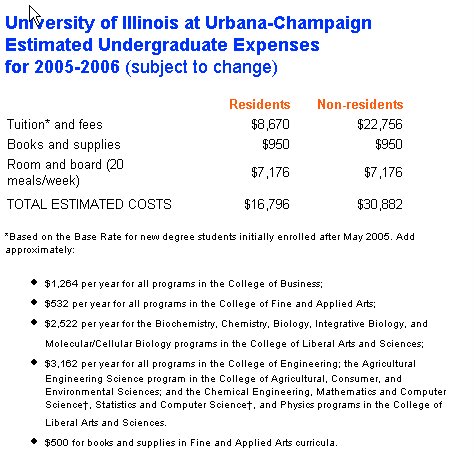
Here is a chart of current costs at the University of Illinois.


Look closely and you will see that you need to add an extra $2,522 per year for the Biochemistry, Chemistry, Biology, Integrative Biology, and Molecular/Cellular Biology programs; and $3,162 per year for all programs in the College of Engineering.

With the add-ons the cost comes close to $20,000 per year. That is for the University of Illinois too. Private schools are much more expensive. Not having children, I can not fathom what it might be like attempting to put two kids (four? yikes!) through college. Nor can I fathom going to school for four years and ending up close to $100,000 in debt upon graduation. That does not count medical school, graduate school or a law degree either.

It seems kids are being indoctrinated to the idea of being enormously in debt right out of college, while parents are going ever deeper in debt in a struggle to help out.

After graduation, the next big hurdle is finding a job at an adequate pay scale to pay back college loans. Does it even pay to get an advanced technical or computer engineering degree? Not if the outsourcing trend continues as it has been going.

We are Outsourcing the Soul of America.

Business Week discussed this idea in "Outsourcing Innovation"
When Western corporations began selling their factories and farming out manufacturing in the '80s and '90s to boost efficiency and focus their energies, most insisted all the important research and development would remain in-house.

But that pledge is now passé. Today, the likes of Dell, Motorola, and Philips are buying complete designs of some digital devices from Asian developers, tweaking them to their own specifications, and slapping on their own brand names. It's not just cell phones. Asian contract manufacturers and independent design houses have become forces in nearly every tech device, from laptops and high-definition TVs to MP3 music players and digital cameras. "Customers used to participate in design two or three years back," says Jack Hsieh, vice-president for finance at Taiwan's Premier Imaging Technology Corp., a major supplier of digital cameras to leading U.S. and Japanese brands. "But starting last year, many just take our product. Because of price competition, they have to."

Boeing Co. is working with India's HCL Technologies to co-develop software for everything from the navigation systems and landing gear to the cockpit controls for its upcoming 7E7 Dreamliner jet. Pharmaceutical giants such as GlaxoSmithKline (GSK) and Eli Lilly (LLY)are teaming up with Asian biotech research companies in a bid to cut the average $500 million cost of bringing a new drug to market. And Procter & Gamble Co. (PG) says it wants half of its new product ideas to be generated from outside by 2010, compared with 20% now.

Some analysts even see a new global division of labor emerging: The rich West will focus on the highest levels of product creation, and all the jobs of turning concepts into actual products or services can be shipped out.

Consultant Daniel H. Pink, author of the new book A Whole New Mind, argues that the "left brain" intellectual tasks that "are routine, computer-like, and can be boiled down to a spec sheet are migrating to where it is cheaper, thanks to Asia's rising economies and the miracle of cyberspace." The U.S. will remain strong in "right brain" work that entails "artistry, creativity, and empathy with the customer that requires being physically close to the market."
Are the "right brains" somehow deficient in citizens from China or India? Somehow, I think not. With China and India turning out more engineers and the US "dumbing down" math and science with "unintelligent design" concepts, it's hard to see how we are going to maintain any creative edge if and when China decides to free up its academia from political interference. Unfortunately for the US, our academic paths now seem to be crossing. China seems to be opening up its academia while the US is reverting to religious fanaticism.

Combine religious fanaticism, rising tuition costs, and wage pressures (especially for computer engineers), with massive outsourcing of everything that is not tied down and you have the makings of an Education Gap that is destined to get much, much worse.

Mike Shedlock / Mish
http://globaleconomicanalysis.blogspot.com/

الخميس، 3 نوفمبر 2005

The President’s Advisory Panel on Tax Reform

Here is a report by the President’s Advisory Panel on Tax Reform.

Notes:
  • The above link points to a 92 page PDF document.
  • It will take some time to read, but it is well presented and definitely worth a look.
  • There are two options presented by the tax panel. One is called "The Simplified Income Tax Plan"; the other is called "The Growth and Investment Tax Plan". Many features are the same under both plans but there are differences especially when it comes to savings.
  • Some of the differences between the plans as well as my conclusions are discussed below.
Mish Conclusions:
The panel's recommendations are a very good start at reform but the proposals could in theory be even simpler (i.e. a flat tax or consumption tax). However, the modifications suggested by the panel vs. the present tax nightmare are quite substantial. The panel attempted in good faith to address many fairness issues and come up with recommendations that stand a chance at getting passed. That is the key. A theoretical better solution would do no good if Congress would not pass it.

No doubt the national association of realtors (among others) will be all stirred up over some of the recommendations, such as reducing the interest deduction allowed for homes. As long as that deduction must remain (and for political reasons it probably must remain in some form), the idea to limit home deductions yet spread them out so that more people qualify seems more fair than the current system. Allowing interest rate deductions on second homes never made any sense and the panel was wise to reject that totally. The idea to cap the deduction also makes sense.

Personally, I do not think it should be the goal of government to encourage the purchase of certain asset classes at all. In that regard, I believe one of many reasons housing is not affordable now, is the fact that there are currently 80 bills that encourage "affordable housing". If it was up to me, I would scrap them all, right along with Fannie Mae.

That said, there is "ideal" and there is "possible". The panel's proposals are far more likely to fly than any kind of "flat tax" that might eliminate all deductions such as interest paid on mortgages. A flat tax would likely be viewed by many as "too radical". There are just too many vested interest groups that would pick apart such proposals.

The AMT is eliminated.

Everyone should applaud the panel’s recommendation to eliminate the nightmare known as the Alternative Minimum Tax (AMT). With the Panel’s recommendations, millions of taxpayers would no longer have to take on a complex series of calculations just to determine whether they are entitled to a tax benefit or whether it is taken away by the AMT. Here is what the panel had to say:

The AMT is an entirely separate tax system with its own definitions, exclusions, deductions, credits, and tax rates. It is the most vivid example of the wasteful complexity that has been built into our system to limit the availability of some tax benefits. The AMT was conceived as a way to make all Americans pay tax, regardless of their tax shelters and avoidance efforts. But over time, the AMT’s simple mission has been made more complex and less effective. For example, as part of the 1986 tax reform effort, lawmakers who eliminated the state sales tax deduction nonetheless preserved an itemized deduction for state and local property and income taxes – but only for those paying under the regular tax system. For those subject to the AMT system, the income and property tax deductions were eliminated as well. At that time, this rule had little significance for most taxpayers, but it is increasingly relevant as the reach of the AMT, which is not indexed for inflation, has grown.

Eliminating the AMT would free millions of middle-class taxpayers – 21.6 million in 2006 and 52 million in 2015 – from filing the forms, preparing the worksheets, and making the seemingly endless calculations required to determine their AMT liability. In 2004, an individual had to fill out a 12-line worksheet to see if he needed to file Form 6251, a 55-line form with eight pages of instructions. Those eight pages of instructions also tell the individual to redo many regular tax forms and schedules, including Forms 4952 (Investment Interest Expense Deduction), 4684 (Casualties and Thefts), 4797(Sales of Business Property), and Schedule D (Capital Gains and Losses) using the AMT rules. The individual may also have to fill out and file Forms 8582 (Passive Activity Loss Limitation) and 1116 (Foreign Tax Credit) on an AMT basis. The taxpayer also has to fill out a 48-line form (Form 8801) to determine whether he is entitled to credits for prior AMT payments. Finally, the instructions warn that if the taxpayer claimed the standard deduction for regular taxes, he should recalculate his regular and AMT taxes using itemized deductions because while the standard deduction is not available under the AMT, some itemized deductions are, but only if the individual itemizes for purposes of the regular tax.

Personal Exemptions, Child Tax Credits, Earned Income Credit, and the Marriage Penalty have all been addressed.

A recommendation was made to consolidate the standard deduction, personal exemptions, child tax credit, and head of household filing status into a single “Family Credit”. A recommendation was made to consolidate the earned income tax credit and refundable child tax credit into a single “Work Credit”. Both of these are good ideas. These ideas will eliminate many complex forms replacing them with a simpler one, while encouraging more people to work as opposed to stay on welfare.

Other highlights:
The Panel's recommendations would simplify the tax treatment of Social Security benefits and help reduce the marriage penalty as follows: options would make all marginal tax rate brackets, the Family Credit for married couples, and the Social Security benefits deduction thresholds exactly twice the amount for singles. By providing marriage penalty relief, the Panel’s options help reduce the barriers faced by potential second earners.

Reducing Disincentives to Save
It was encouraging to see the panel address the savings rate.

Household saving is crucial to the health of our economy and to the financial health of American families. An income tax reduces the return to saving because it taxes the income that saving generates. An individual who earns a dollar today pays taxes on those wages. If he then consumes the after-tax proceeds, he will not pay any further taxes. In contrast, someone who earns the same amount today, pays the same taxes on his wage income, but then decides to save the proceeds will be subject to additional tax in the future on the investment income generated from savings. A person weighing whether to spend money today or save it for the future may compare how much he can buy today against what he will be able to buy in the future with his savings. If the return on savings is subject to tax, current consumption will be less expensive than future consumption financed from savings. The tax on savings therefore operates like a penalty for those who choose to save.

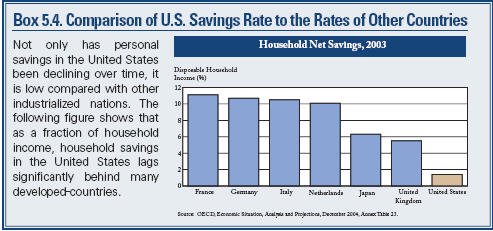
Following is one of the charts presented in the PDF:


Mish readers will not that the chart is way out of date. The current national savings rate is -1.6% (as in we are spending more money than we are making which of course is not only staggering on an national basis but also unsustainable).

The panel's recommendation is to simplify and expand opportunities for tax-free savings for retirement, health, education, and housing. Following is the pertinent discussion:

The Simplified Income Tax Plan would nearly eliminate the double tax on corporate profits by excluding dividends paid out of income earned in the U.S. In addition, 75 percent of capital gains on sales of stock in U.S. corporations would be excluded from income.

Under the Growth and Investment Tax Plan, the return to savings not held in these tax-preferred savings accounts would be subject to a flat rate tax of 15 percent. In addition, the simplified employer-sponsored accounts would use a “Roth IRA,” or prepayment approach, while the Simplified Income Tax Plan would use a “traditional IRA,” or postpayment approach. These two approaches provide similar incentives for savers, but they have different near-term tax revenue consequences. The overall tax burden on capital income would be lower under the Growth and Investment Tax Plan than under the Simplified Income Tax Plan, although some types of capital income might have a lower tax burden under the Simplified Income Tax Plan.

Both of the Panel’s recommended options would remove existing disincentives to save. These options would provide opportunities for Americans to save in a simple and efficient manner by replacing the tax code’s plethora of savings incentives with a unified system that would make tax-free savings for education, health, a new home, or retirement flexible, convenient, and straightforward. The tax code’s redundant savings incentives and accounts would be combined into three simple and flexible accounts for savings. The creation of these three simple saving opportunities significantly reduces the bias against saving and investment that exists under the current system. In addition, the Panel proposes changes to the administrative rules for some employer plans that would point workers in a pro-saving direction. The plans would allow most Americans to prepare for their future financial security free of tax. Not only would these accounts provide simpler and expanded opportunities to save, the playing field for tax-preferred savings would be leveled by eliminating exclusions under current law that allow some taxpayers to save an unlimited amount tax-free through life insurance, annuities, and executive deferred compensation arrangements. The Panel’s plans also would include a refundable Saver’s Credit that would give low-income Americans a strong incentive to save by matching contributions to savings accounts.

These approaches would diminish the need for taxpayers to hire tax professionals to help them navigate the tax code’s multitude of incentives. Americans would be able to make investment decisions based on their preferred investment strategy and no longer would be required to jump through hoops to make sure that they maximize their after-tax returns. Taxes would play a less prominent role in household savings decisions.

Given the partisan nature of Congress, as well as the likely nitpicking by groups feeling they were "unfairly picked on" by the proposed changes, the question remains as to what will happen in Congress over these proposals. The devil will be in the details as worked out by Congress, and therein lies another problem.

It can and has taken years just to address this mess and there might not be another chance for years more to come. The temptation for Congress to meddle with the Panel's recommendations will be extremely high. Lobbyists will be all over many if not all of these proposals in one second flat.

Is this proposal really revenue neutral?

The biggest problem I have with the set of proposals is simple: I fail to see how it can possibly be tax neutral. Let's see: we are getting rid of the AMT, reducing the marriage penalty, encouraging more tax free savings, and eliminating double taxation of dividends. In return, there is a reduction of part of the home interest deduction, elimination of deductions for state and local income taxes, and ending preferential treatment of employer provided fringe benefits such as childcare, life insurance premiums, and education costs. Even though part of the home interest reduction was eliminated, the plan was broadened such that more people who do not itemize are likely to benefit than before.

I can easily believe some recommendations are revenue neutral (like replacing Earned Income Credit and other complicated nonsense with a single "work credit"), but others such as eliminating the AMT seem to take a huge "leap of faith". The panel ended its discussion on the AMT with the conclusion that the AMT could be eliminated because they were "broadening the tax base". I am not exactly sure how any of their proposals did just that, at least enough to matter considering that the revenue generated by the AMT is expected to exceed regular tax revenues by 2013. It's too bad the report did not put a "price tag" on each proposal. Then again, putting a price tag on each proposal might have encouraged too much Congressional bickering. Perhaps it best to just take that "leap of faith".

To the extent that this plan is not revenue neutral, I certainly am all in favor of slashing the military budget, pulling all of our troops out of Iraq, Europe, Japan and South Korea, and reducing military expenditures enough to pay for any shortfalls. While we are at it, I would eliminate funding for the arts, a lot of foreign aid, bridges to nowhere in Alaska, crop subsidies, and probably a ton of other needless expenses as well.

Then again, even if the plan is revenue neutral, I am still in favor of slashing the military budget, pulling all of our troops out of Iraq, Europe, Japan and South Korea, reducing military expenditures, elimination of funding for the arts, cutting back on foreign aid, canceling projects that would build bridges to nowhere in Alaska, etc etc etc in order to help balance the budge deficit. It's high time we see some sense of fiscal responsibility out of this administration.

The bottom line is what matters and here it is: The panel's recommendations were probably a "best effort" at producing a significant proposal that will simplify the tax code, make it fairer, and have some chance of making its way through Congress. All in all, Mish applauds the work of The President’s Advisory Panel on Tax Reform.

Mike Shedlock / Mish
http://globaleconomicanalysis.blogspot.com/